Summary:
- Master Adobe’s 2026 interview process across five to six rounds covering online assessments, data structures, System Design, and behavioral evaluation for roles from intern to senior MTS.
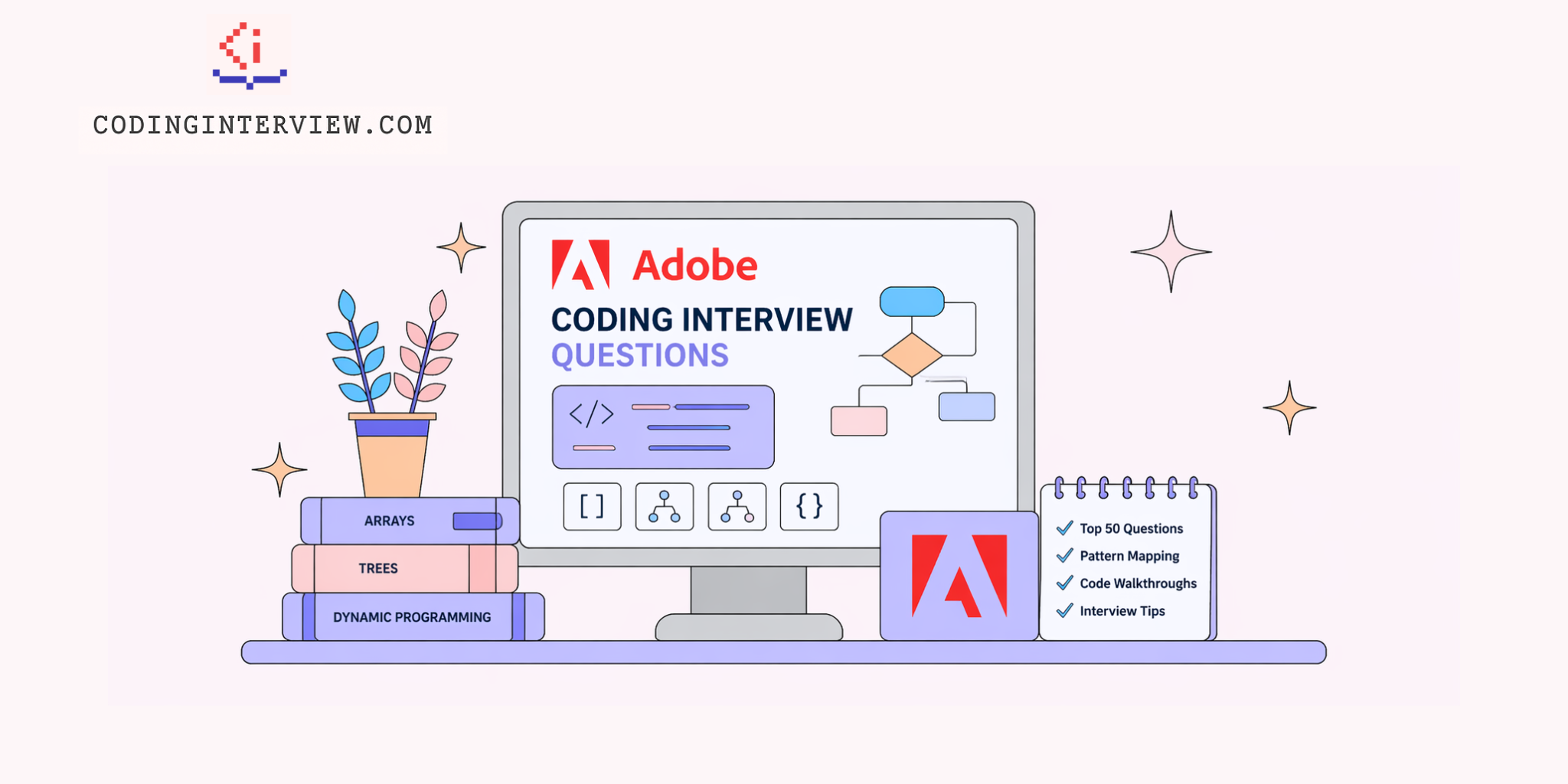
- Practice the 50 most frequently asked Adobe coding interview questions spanning arrays, trees, graphs, dynamic programming, and concurrency patterns with detailed walkthroughs.
- Understand role-specific variations for frontend, backend, and machine learning positions, including JavaScript/TypeScript deep-dives and ML System Design challenges.
- Leverage comparative frequency tables and a downloadable cheat sheet mapping coding patterns to real Adobe problems for targeted preparation.
Adobe’s engineering interviews have evolved significantly in 2026. They now blend classic algorithmic challenges with modern System Design scenarios that reflect the company’s shift toward AI-powered creative tools like Firefly and cloud-native document services. Whether you are targeting an internship, a Member of Technical Staff (MTS) role, or a senior architect position, understanding the specific Adobe coding interview questions you will face gives you a decisive advantage over candidates who prepare generically.
This guide aggregates insights from recent candidate experiences, internal hiring patterns, and Adobe’s publicly documented engineering values to deliver 50 high-frequency questions across every interview stage. Beyond listing problems, you will find solution walkthroughs with complexity analysis, role-level distinctions, and strategic preparation frameworks that competitors overlook. Consider the following sections your comprehensive roadmap to Adobe interview success.

Understanding Adobe’s 2026 interview structure
Adobe’s hiring process in 2026 typically spans five to six rounds, though this varies by role seniority and geographic location. The journey begins with an online assessment hosted on Adobe’s proprietary platform, featuring two to three algorithmic problems with a 90-minute time limit. Successful candidates advance to a phone screen with a recruiter, followed by three to four technical interviews that progressively increase in complexity. The final stage involves a behavioral round with a hiring manager focused on Adobe’s core values of creativity, collaboration, and customer obsession.
For intern and new graduate positions, expect heavier emphasis on data structures and algorithms with lighter System Design exposure. Mid-level MTS candidates face balanced coverage across coding, object-oriented design, and basic distributed systems concepts. Senior and staff engineers encounter deep architectural discussions involving scalability, fault tolerance, and cross-service integration patterns relevant to Adobe’s Creative Cloud infrastructure.
Online assessment format and expectations
The online assessment serves as Adobe’s primary screening mechanism, filtering candidates before investing engineer time in live interviews. You will encounter two to three problems ranging from medium to hard difficulty on platforms similar to HackerRank’s interface. Problems typically cover string manipulation, array traversal, tree operations, and dynamic programming fundamentals.
Time management proves critical since partial solutions earn partial credit. This makes it strategic to submit working code for easier problems before tackling complex ones. Adobe’s assessment platform evaluates both correctness and code quality. Interviewers review submissions for clean variable naming, appropriate function decomposition, and edge case handling.
The following breakdown illustrates typical assessment composition:
- Problem 1 (Easy-Medium): Array or string manipulation testing basic algorithmic thinking
- Problem 2 (Medium): Tree or graph traversal requiring recursive or iterative solutions
- Problem 3 (Medium-Hard): Dynamic programming or advanced data structure application
Core data structures and algorithms questions
Adobe’s coding interview questions consistently emphasize fundamental data structures, with arrays, strings, trees, and graphs appearing in over 80% of reported coding rounds. Mastery of these topics forms the foundation for tackling Adobe coding interview questions at any level. The company values candidates who demonstrate not just working solutions but also articulate time-space tradeoffs and identify edge cases proactively.
The following table compares question type frequency across different role levels based on 2026 candidate reports. Use this data to prioritize your preparation based on your target position.
| Question category | Intern frequency | MTS-1/MTS-2 frequency | Senior/Staff frequency |
|---|---|---|---|
| Arrays and strings | Very high | High | Medium |
| Trees and graphs | High | Very high | High |
| Dynamic programming | Medium | High | Medium |
| System Design | Low | Medium | Very high |
| Concurrency | Low | Medium | High |
| OOP design | Medium | High | Medium |
Array and string problems
Array manipulation questions test your ability to optimize brute-force solutions using techniques like the sliding window pattern, two-pointer traversal, and prefix sum arrays. Adobe frequently asks variations of substring problems, particularly those involving pattern matching relevant to their document processing systems. String questions often connect to real Adobe use cases like text search in PDFs or font rendering optimization.
Here are ten high-frequency array and string questions reported by recent Adobe candidates:
- Find the longest substring without repeating characters
- Implement a sliding window maximum for a given window size
- Merge overlapping intervals in a meeting scheduler
- Find all anagrams of a pattern in a given string
- Rotate an array by k positions in-place
- Determine if two strings are one edit distance apart
- Find the minimum window substring containing all characters
- Implement string compression (run-length encoding)
- Find the longest palindromic substring
- Trapping rain water between elevation bars
Tree and graph traversal challenges
Tree problems at Adobe frequently involve binary search trees, n-ary trees, and trie structures. Graph questions often model real scenarios like dependency resolution in build systems or network topology analysis for Creative Cloud services. Candidates should be comfortable with both recursive and iterative implementations, as interviewers may request conversions between approaches to test depth of understanding.
The following code demonstrates a solution to a frequently asked Adobe question. It finds the lowest common ancestor in a binary tree. This problem tests understanding of tree traversal and recursive problem decomposition.
 JAVA
JAVAclass="cm-comment">// Find lowest common ancestor of two nodes in binary tree
public TreeNode lowestCommonAncestor(TreeNode root, TreeNode p, TreeNode q) {
class="cm-comment">// Base case: null root or found target node
if (root == null || root == p || root == q) {
return root;
}
class="cm-comment">// Recursively search left and right subtrees
TreeNode left = lowestCommonAncestor(root.left, p, q);
TreeNode right = lowestCommonAncestor(root.right, p, q);
class="cm-comment">// If both subtrees return non-null, current node is LCA
if (left != null && right != null) {
return root;
}
class="cm-comment">// Return non-null result from either subtree
return left != null ? left : right;
}
class="cm-comment">// Time complexity: O(n) where n is number of nodes
class="cm-comment">// Space complexity: O(h) where h is tree height for recursion stack
Recursive lowest common ancestor solution with O(n) time complexity
Additional tree and graph questions frequently appearing in Adobe interviews include:
- Serialize and deserialize a binary tree
- Validate if a binary tree is a valid BST
- Find the diameter of a binary tree
- Clone a graph with random pointers
- Detect a cycle in a directed graph
- Find shortest path in an unweighted graph using BFS
- Implement a trie for autocomplete functionality
- Count connected components in an undirected graph
Dynamic programming and optimization
Dynamic programming questions at Adobe test your ability to identify overlapping subproblems and optimal substructure. These problems often appear in the final round of technical interviews, serving as differentiators between candidates. Adobe interviewers appreciate candidates who start with a recursive solution, identify redundant computations, and systematically optimize using memoization or tabulation.
Common dynamic programming patterns include:
- Linear DP: House robber, maximum subarray, climbing stairs variations
- 2D DP: Longest common subsequence, edit distance, unique paths in grid
- Interval DP: Matrix chain multiplication, burst balloons
- State machine DP: Best time to buy and sell stock with cooldown
System Design and OOP design questions
System Design questions at Adobe reflect the company’s massive scale, serving over 300 million Creative Cloud users globally. Even mid-level candidates face basic architectural discussions, while senior engineers must demonstrate expertise in distributed systems, data consistency models, and service decomposition. Adobe’s infrastructure relies heavily on Amazon Web Services and proprietary systems, making cloud architecture knowledge particularly valuable.
Object-oriented design questions test your ability to model real-world systems using SOLID principles and design patterns. Adobe values clean abstractions that enable extensibility, reflecting their plugin-based architecture in products like Photoshop and Illustrator. These questions typically require whiteboard modeling followed by partial implementation.
Frequently asked System Design problems
Adobe System Design interviews typically last 45 to 60 minutes. They begin with requirements clarification and progress through high-level architecture, component deep-dives, and scalability discussions. Interviewers evaluate your ability to make reasonable assumptions, identify bottlenecks, and propose solutions that balance consistency, availability, and partition tolerance according to the CAP theorem.
The following System Design questions appear frequently in Adobe senior-level interviews:
- Design a real-time collaborative document editing system (similar to Adobe Acrobat web)
- Design a content delivery network for serving Creative Cloud assets globally
- Design an image processing pipeline that handles millions of uploads daily
- Design a notification system for Creative Cloud subscription events
- Design a rate limiter for Adobe’s public APIs
- Design a search system for Adobe Stock’s image library
- Design a video transcoding service with priority queuing
Object-oriented design challenges
OOP design questions at Adobe often involve modeling familiar systems with emphasis on extensibility and maintainability. Interviewers expect you to identify key entities, define relationships, apply appropriate design patterns, and discuss tradeoffs in your approach. Common patterns include Factory, Strategy, Observer, and Decorator, all heavily used in Adobe’s plugin architectures.
Frequently asked OOP design problems include:
- Design a parking lot management system
- Design a library management system with multiple user types
- Design a file system with support for different file types
- Design a chess game with move validation
- Design an elevator system for a multi-floor building
- Design a plugin architecture for an image editor
Role-specific interview variations
Adobe tailors interview content based on the specific team and role you are targeting. Frontend engineers face JavaScript-heavy assessments with DOM manipulation and framework-specific questions. Backend candidates encounter more System Design and concurrency challenges. Machine learning roles include specialized coding problems involving data processing pipelines and model serving infrastructure.
Frontend engineering focus areas
Frontend interviews at Adobe emphasize JavaScript fundamentals, TypeScript proficiency, and framework expertise in React or Angular. Candidates should expect questions about event handling, asynchronous programming with Promises and async/await, and performance optimization techniques. Adobe’s web applications like Adobe Express require engineers who understand browser rendering pipelines and can optimize for Core Web Vitals.
The following code demonstrates a debounce implementation, a common Adobe frontend interview question testing understanding of closures and timing functions.
 JAVASCRIPT
class="cm-comment">// Implement debounce function for search input optimization
function debounce(func, delay) {
let timeoutId;
return function(...args) {
class="cm-comment">// Clear previous timeout to reset delay
clearTimeout(timeoutId);
class="cm-comment">// Set new timeout with specified delay
timeoutId = setTimeout(() => {
func.apply(this, args);
}, delay);
};
}
class="cm-comment">// Usage example for search input
const searchHandler = debounce((query) => {
console.log(class="cm-string">&class="cm-comment">#039;Searching for:', query);
class="cm-comment">// API call would go here
}, 300);
Debounce implementation using closures for search input optimization
Additional frontend-specific questions include implementing throttle functions, creating custom hooks in React, handling infinite scroll with virtualization, and optimizing bundle sizes for Creative Cloud web applications.
Machine learning engineering challenges
Adobe’s machine learning roles, particularly those supporting Adobe Firefly and Sensei AI, require specialized preparation. Interviews combine traditional coding assessments with ML-specific problems involving data preprocessing, feature engineering, and model evaluation. Candidates should understand distributed training concepts and model serving architectures.
ML engineering questions frequently asked at Adobe include:
- Implement k-means clustering from scratch
- Design a feature store for real-time model inference
- Optimize a recommendation system for Adobe Stock
- Implement batch normalization forward and backward passes
- Design an A/B testing framework for ML model deployment
Behavioral questions and cultural fit
Adobe’s behavioral interviews assess alignment with the company’s core values. These are genuine, exceptional, innovative, and involved. Interviewers use the STAR method (Situation, Task, Action, Result) to evaluate past experiences. Prepare specific examples demonstrating collaboration, handling ambiguity, receiving feedback, and driving projects to completion.
Common behavioral questions at Adobe include:
- Describe a time you disagreed with a technical decision. How did you handle it?
- Tell me about a project where requirements changed significantly mid-development.
- How do you prioritize when facing multiple urgent deadlines?
- Describe your approach to mentoring junior engineers.
- Tell me about a time you failed and what you learned from it.
- How do you stay current with evolving technologies?
Concurrency and advanced topics
Senior candidates and those targeting backend infrastructure roles face concurrency questions testing understanding of thread safety, synchronization primitives, and deadlock prevention. Adobe’s services handle massive concurrent loads, making these skills essential for production systems. Questions often involve implementing thread-safe data structures or designing lock-free algorithms.
Advanced topics appearing in senior Adobe interviews include:
- Implement a thread-safe LRU cache
- Design a producer-consumer queue with bounded capacity
- Implement a read-write lock from scratch
- Explain and implement the dining philosophers solution
- Design a connection pool with timeout handling
Preparation strategy and resources
Effective Adobe interview preparation requires structured practice across multiple dimensions. Begin with fundamental data structures four to six weeks before your interview, progressing to System Design and behavioral preparation in the final two weeks. Track your progress using a spreadsheet that logs problem types, completion times, and areas needing review.
Recommended preparation timeline:
- Weeks 1-2: Arrays, strings, and basic tree problems (15-20 problems)
- Weeks 3-4: Graphs, dynamic programming, and advanced trees (15-20 problems)
- Week 5: System Design fundamentals and OOP design (3-4 complete designs)
- Week 6: Mock interviews, behavioral preparation, and review
Adobe prefers Java, C++, Python, and JavaScript for coding interviews. Choose the language you are most comfortable with, but ensure you can discuss language-specific optimizations and standard library usage. Review Java documentation or equivalent resources for your chosen language before interviews.
Conclusion
Mastering Adobe coding interview questions requires deliberate practice across data structures, System Design, and behavioral competencies tailored to your target role level. The 50 questions covered in this guide represent the highest-frequency problems reported by 2026 candidates. They span arrays, trees, graphs, dynamic programming, and concurrency patterns that Adobe values in production engineers. Adobe evaluates not just correctness but also code quality, communication clarity, and cultural alignment with their creative mission.
As Adobe continues expanding AI-powered features through Firefly and Sensei, expect interview content to evolve toward ML systems and real-time collaborative architectures. Candidates who demonstrate both algorithmic fundamentals and awareness of Adobe’s product ecosystem position themselves as valuable contributors to teams building the next generation of creative tools. Start your preparation today by selecting five problems from each category and committing to consistent daily practice.