
Summary:
- Master 75 carefully curated full stack coding interview questions spanning frontend, backend, databases, System Design, security, and DevOps for 2026 hiring cycles.
- Understand the distinction between junior-level implementation questions and senior-level architectural trade-off discussions that interviewers use to gauge experience depth.
- Gain practical code snippets, a complete System Design walkthrough, and strategic frameworks for answering questions about emerging technologies like edge computing and AI integration.
- Learn how to articulate performance optimization strategies, security best practices, and cloud-native deployment patterns that top companies expect from full stack candidates.
The full stack coding interview landscape in 2026 demands more than memorizing syntax or reciting framework features. Companies now expect candidates to demonstrate end-to-end ownership, from crafting responsive user interfaces to architecting distributed backend systems that handle millions of requests. This comprehensive guide presents 75 of the most common full stack coding interview questions you will encounter this year, organized by domain and difficulty level. Whether you are preparing for your first developer role or targeting a senior engineering position, these questions reflect what hiring managers at leading technology companies actively assess during technical screens and onsite interviews.
The following diagram illustrates how modern full stack interviews typically progress through multiple technical domains, each building upon the previous layer of complexity.

The 2026 full stack interview landscape
Full stack coding interview questions in 2026 reflect significant shifts in how companies build and deploy software. The rise of edge computing, AI-assisted development tools, and serverless architectures has expanded the knowledge surface area that interviewers probe. Candidates must now demonstrate familiarity with technologies that barely existed in mainstream production environments just two years ago. Understanding these trends helps you prioritize your preparation and anticipate the direction interviewers will take during technical discussions.
Several key themes dominate this year’s interview cycles. First, interviewers increasingly assess candidates on their ability to reason about distributed systems, even for mid-level positions. Second, security has moved from a specialized concern to a baseline expectation, with questions about authentication flows and data protection appearing in nearly every full stack interview. Third, the boundary between frontend and backend continues to blur as frameworks like Next.js and server components reshape how developers think about rendering strategies.
The questions in this guide are organized to mirror how interviewers typically structure their assessments. We begin with frontend fundamentals before progressing through backend systems, database design, and culminating in System Design scenarios that test your ability to synthesize knowledge across the entire stack.
Frontend interview questions
Frontend coding interview questions in full stack interviews assess your understanding of browser behavior, modern JavaScript patterns, and framework-specific concepts. Interviewers want to see that you can build performant, accessible user interfaces while understanding the underlying mechanisms that make them work. The questions below range from fundamental concepts that every candidate should master to advanced topics that distinguish senior engineers.
Core JavaScript and browser fundamentals
Understanding the event loop remains one of the most frequently tested concepts in frontend interviews. Interviewers use this topic to gauge whether candidates truly understand asynchronous JavaScript or merely copy patterns without comprehension. The event loop determines how JavaScript handles concurrent operations despite being single-threaded, making it essential for debugging performance issues and race conditions.
Consider the following JavaScript interview questions that appear regularly in 2026 interviews:
- Question 1: Explain how the JavaScript event loop processes the call stack, microtask queue, and macrotask queue.
- Question 2: What is the difference between setTimeout with zero delay and Promise.resolve().then()?
- Question 3: How does the browser’s rendering pipeline interact with JavaScript execution?
- Question 4: Describe closure behavior and provide an example where closures cause memory leaks.
- Question 5: What are Web Workers and when would you use them instead of async/await?
The following code demonstrates event loop behavior that interviewers frequently ask candidates to trace through and predict the output order.
 JAVASCRIPT
class="cm-comment">// Event loop execution order demonstration
console.log(class="cm-string">&class="cm-comment">#039;1: Synchronous start');
setTimeout(() => {
console.log(class="cm-string">&class="cm-comment">#039;2: Macrotask from setTimeout');
}, 0);
Promise.resolve()
.then(() => console.log(class="cm-string">&class="cm-comment">#039;3: Microtask from Promise'))
.then(() => console.log(class="cm-string">&class="cm-comment">#039;4: Chained microtask'));
queueMicrotask(() => console.log(class="cm-string">&class="cm-comment">#039;5: Explicit microtask'));
console.log(class="cm-string">&class="cm-comment">#039;6: Synchronous end');
class="cm-comment">// Output order: 1, 6, 3, 5, 4, 2
Event loop execution demonstrating microtask priority over macrotasks
Modern framework and state management questions
Framework-specific questions in 2026 focus heavily on React, Vue, and increasingly on meta-frameworks that handle server-side rendering. Interviewers assess whether candidates understand the trade-offs between different state management approaches rather than simply knowing API syntax. Senior candidates should be prepared to discuss when global state becomes an anti-pattern and how to architect component hierarchies that minimize unnecessary re-renders.
The following questions represent common framework assessments:
- Question 6: Compare React’s useState, useReducer, and external state managers like Zustand or Jotai for different application scales.
- Question 7: How do React Server Components change the mental model for data fetching?
- Question 8: Explain Vue’s reactivity system and how it differs from React’s reconciliation approach.
- Question 9: What problems does the Signals pattern solve that hooks do not address?
- Question 10: How would you implement optimistic updates in a React application?
| State management approach | Best suited for | Trade-offs |
|---|---|---|
| Local component state | UI-only state, form inputs | Cannot share across component trees |
| Context API | Theme, authentication, localization | Re-renders all consumers on any change |
| Zustand/Jotai | Medium complexity shared state | Additional dependency, learning curve |
| Redux Toolkit | Large applications with complex flows | Boilerplate overhead, steeper learning curve |
| Server state (TanStack Query) | API data caching and synchronization | Not suitable for purely client-side state |
Understanding when to reach for each tool demonstrates the architectural thinking that separates senior candidates from those who apply the same solution to every problem. With frontend fundamentals established, we now transition to backend coding challenges where interviewers assess your ability to build robust APIs and handle server-side complexity.
Backend coding challenges
Backend interview questions evaluate your ability to design APIs, handle concurrent requests, and implement business logic that scales. Interviewers in 2026 expect candidates to demonstrate proficiency in at least one backend language while understanding the principles that transfer across technology stacks. The questions below cover Node.js, Python, and language-agnostic concepts that appear in most full stack interviews.
API design and RESTful principles
REST remains the dominant API paradigm, though GraphQL questions appear with increasing frequency. Interviewers assess whether candidates understand HTTP semantics, status codes, and resource modeling rather than simply knowing how to create endpoints. Senior candidates should be prepared to discuss API versioning strategies, rate limiting implementation, and backward compatibility concerns.
- Question 11: Design a RESTful API for a social media platform’s post and comment system.
- Question 12: When would you choose GraphQL over REST, and what are the performance implications?
- Question 13: How do you handle partial updates with PUT versus PATCH semantics?
- Question 14: Explain idempotency and why it matters for API design.
- Question 15: How would you implement pagination for a resource with millions of records?
Asynchronous patterns and concurrency
Backend systems must handle multiple simultaneous requests without blocking. Interviewers probe your understanding of async/await patterns, connection pooling, and the differences between concurrency models across languages. These questions reveal whether candidates can debug production issues related to deadlocks, race conditions, and resource exhaustion.
The following code demonstrates a common interview pattern where candidates must identify potential issues with concurrent database operations.
JAVASCRIPTclass="cm-comment">// Problematic concurrent balance update - race condition example
async function transferFunds(fromAccount, toAccount, amount) {
class="cm-comment">// Race condition: both reads happen before either write
const fromBalance = await db.getBalance(fromAccount);
const toBalance = await db.getBalance(toAccount);
if (fromBalance < amount) {
throw new Error(class="cm-string">&class="cm-comment">#039;Insufficient funds');
}
class="cm-comment">// Another transaction could modify balances between read and write
await db.setBalance(fromAccount, fromBalance - amount);
await db.setBalance(toAccount, toBalance + amount);
}
class="cm-comment">// Correct approach using database transactions
async function transferFundsSafe(fromAccount, toAccount, amount) {
return db.transaction(async (trx) => {
const fromBalance = await trx.getBalanceForUpdate(fromAccount);
if (fromBalance < amount) throw new Error(class="cm-string">&class="cm-comment">#039;Insufficient funds');
await trx.decrementBalance(fromAccount, amount);
await trx.incrementBalance(toAccount, amount);
});
}
Race condition in fund transfers and transaction-based solution
Additional backend questions that frequently appear include:
- Question 16: How does Node.js handle 10,000 concurrent connections with a single thread?
- Question 17: Compare async/await error handling patterns in Node.js versus Python.
- Question 18: What is backpressure and how do you handle it in streaming scenarios?
- Question 19: Explain connection pooling and how to size pools appropriately.
- Question 20: How would you implement a job queue for background processing?
Backend proficiency extends naturally into database design, where interviewers assess your ability to model data and write efficient queries. The next section covers database interview questions that test both SQL and NoSQL knowledge.
Database interview questions
Database questions in full stack interviews range from basic query writing to complex discussions about data modeling, indexing strategies, and consistency trade-offs. Interviewers expect candidates to understand when to choose SQL versus NoSQL solutions and to articulate the reasoning behind their decisions. These questions often reveal the depth of a candidate’s production experience.
SQL fundamentals and query optimization
Relational database questions test your ability to write correct queries and understand execution plans. Interviewers frequently present slow queries and ask candidates to identify optimization opportunities. Understanding indexes, joins, and the ACID properties remains essential for any full stack developer working with persistent data.
Common SQL interview questions include:
- Question 21: Write a query to find the second highest salary in an employees table.
- Question 22: Explain the difference between INNER JOIN, LEFT JOIN, and CROSS JOIN.
- Question 23: How do database indexes work and when can they hurt performance?
- Question 24: What is the difference between clustered and non-clustered indexes?
- Question 25: Explain transaction isolation levels and their trade-offs.
NoSQL and polyglot persistence
Modern applications often combine multiple database technologies, each optimized for specific access patterns. Interviewers assess whether candidates can evaluate trade-offs between consistency, availability, and partition tolerance as described by the CAP theorem. Understanding when to denormalize data or choose eventual consistency demonstrates architectural maturity.
| Database type | Optimal use case | Consistency model |
|---|---|---|
| PostgreSQL | Complex queries, transactions, relational data | Strong consistency |
| MongoDB | Document storage, flexible schemas, rapid iteration | Configurable (strong to eventual) |
| Redis | Caching, session storage, real-time leaderboards | Eventual (with persistence options) |
| Cassandra | High write throughput, time-series data | Tunable consistency |
| DynamoDB | Serverless applications, predictable performance | Eventual (strong optional) |
Additional database questions that test deeper understanding:
- Question 26: When would you choose MongoDB over PostgreSQL for a new project?
- Question 27: Explain sharding strategies and their impact on query patterns.
- Question 28: How do you handle schema migrations in production without downtime?
- Question 29: What is database connection pooling and how do you configure it?
- Question 30: Describe the CAP theorem and provide examples of CP versus AP systems.
Database knowledge forms the foundation for System Design discussions, where interviewers expect candidates to synthesize frontend, backend, and data layer decisions into coherent architectures. The following section presents System Design questions with a detailed walkthrough.
System Design questions
System Design interviews evaluate your ability to architect complete solutions that balance functionality, scalability, and maintainability. These questions distinguish senior candidates by revealing how they approach ambiguity, make trade-offs, and communicate technical decisions. Full stack developers should demonstrate comfort designing both the user-facing components and the backend infrastructure that supports them.
Common System Design scenarios
Interviewers typically present open-ended problems and expect candidates to drive the conversation through requirements gathering, high-level design, and deep dives into specific components. The following questions appear frequently in 2026 full stack interviews:
- Question 31: Design a URL shortening service like Bitly.
- Question 32: Architect a real-time collaborative document editor.
- Question 33: Design a notification system that supports email, SMS, and push notifications.
- Question 34: How would you build a rate limiter for an API gateway?
- Question 35: Design a social media feed with personalized ranking.
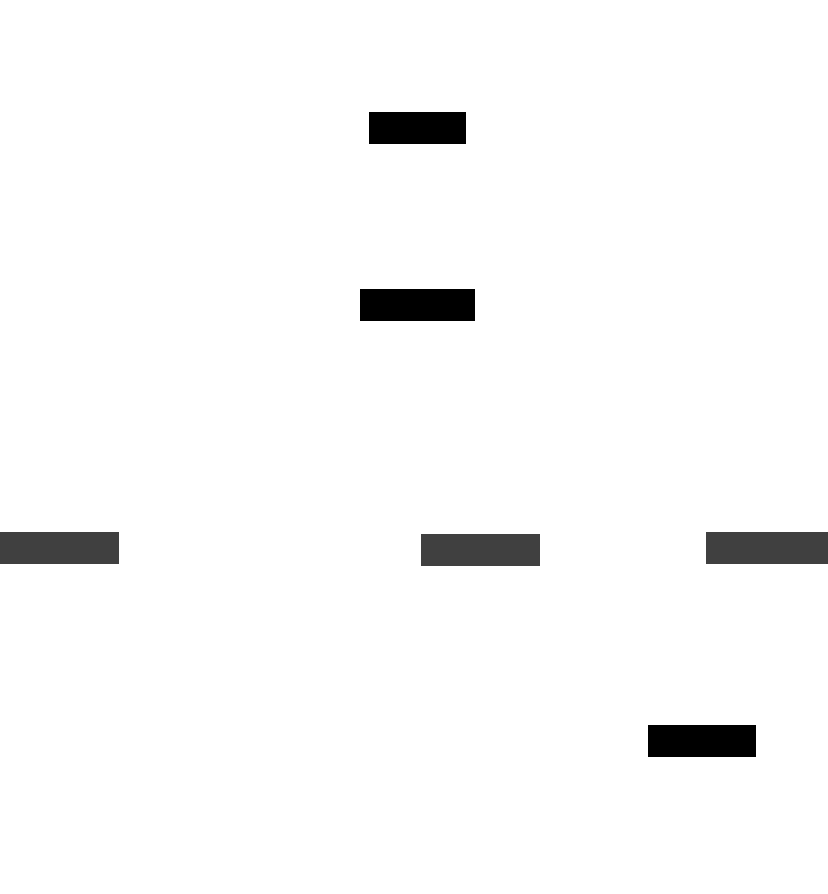
The following diagram illustrates a complete URL shortener architecture that demonstrates the components interviewers expect candidates to discuss.
URL shortener deep dive
A URL shortener appears simple but reveals significant complexity when you consider scale, uniqueness guarantees, and analytics requirements. Senior candidates should discuss the trade-offs between different ID generation strategies, caching policies, and how to handle the read-heavy access pattern typical of shortened URLs.
Key architectural decisions include:
- ID generation: Counter-based (simple but requires coordination), hash-based (collision risk), or snowflake IDs (distributed but complex).
- Encoding: Base62 encoding produces URL-safe strings while maximizing information density.
- Caching strategy: Hot URLs follow a power-law distribution, making caching highly effective with relatively small memory footprint.
- Database choice: Key-value stores excel for simple lookups, but relational databases simplify analytics queries.
Additional System Design questions that test architectural breadth:
- Question 36: How would you design a distributed cache system?
- Question 37: Architect a payment processing system with idempotency guarantees.
- Question 38: Design a search autocomplete feature for an e-commerce site.
- Question 39: How would you build a real-time multiplayer game backend?
- Question 40: Design a file storage system similar to Dropbox.
System Design naturally leads to discussions about performance and security, where interviewers assess whether candidates can identify bottlenecks and protect systems from common attack vectors.
Performance and security interview questions
Performance and security questions reveal whether candidates can build systems that remain fast and safe under real-world conditions. Interviewers expect full stack developers to identify optimization opportunities across the entire request lifecycle and implement security measures that protect user data. These topics have gained prominence as applications handle increasingly sensitive information and face sophisticated attacks.
Performance optimization strategies
Performance questions test your ability to diagnose bottlenecks and apply appropriate solutions. Interviewers often present scenarios with specific symptoms and expect candidates to propose systematic debugging approaches rather than guessing at solutions.
- Question 41: How would you debug a web application that becomes slow after running for several hours?
- Question 42: Explain the critical rendering path and how to optimize it.
- Question 43: What metrics would you monitor to ensure API performance?
- Question 44: How do you implement effective caching at different layers of the stack?
- Question 45: Describe strategies for optimizing database query performance.
Security fundamentals and authentication
Security questions in 2026 interviews cover authentication protocols, common vulnerabilities, and secure coding practices. Interviewers expect candidates to understand OAuth 2.0 flows, JWT token handling, and the OWASP Top 10 vulnerabilities. These questions often include scenario-based problems where candidates must identify security flaws in code samples.
The following code demonstrates secure JWT handling patterns that interviewers frequently discuss.
JAVASCRIPTclass="cm-comment">// Secure JWT verification with proper error handling
const jwt = require(class="cm-string">&class="cm-comment">#039;jsonwebtoken');
function verifyToken(token, publicKey) {
try {
class="cm-comment">// Always specify allowed algorithms to prevent algorithm confusion attacks
const decoded = jwt.verify(token, publicKey, {
algorithms: [class="cm-string">&class="cm-comment">#039;RS256'],
issuer: class="cm-string">&class="cm-comment">#039;https://auth.example.com',
audience: class="cm-string">&class="cm-comment">#039;api.example.com',
clockTolerance: 30 class="cm-comment">// Allow 30 seconds clock skew
});
return { valid: true, payload: decoded };
} catch (error) {
class="cm-comment">// Log for monitoring but return generic error to client
console.error(class="cm-string">&class="cm-comment">#039;Token verification failed:', error.message);
return { valid: false, error: class="cm-string">&class="cm-comment">#039;Invalid token' };
}
}
Secure JWT verification with algorithm restriction and claim validation
Essential security questions include:
- Question 46: Explain the OAuth 2.0 authorization code flow with PKCE.
- Question 47: How do you prevent SQL injection and XSS attacks?
- Question 48: What is CSRF and how do modern frameworks mitigate it?
- Question 49: Describe secure password storage using bcrypt or Argon2.
- Question 50: How do you implement secure session management?
Performance and security knowledge must be operationalized through proper DevOps practices. The next section covers deployment, CI/CD, and cloud-native topics that complete the full stack skill set.
DevOps and cloud deployment questions
DevOps questions assess whether candidates can deploy and operate the systems they build. Full stack developers in 2026 are expected to understand containerization, CI/CD pipelines, and cloud platform fundamentals. These questions reveal whether candidates have production experience beyond local development environments.
Containerization and orchestration
Docker and Kubernetes knowledge has become baseline expectations for full stack roles. Interviewers test understanding of container networking, resource limits, and deployment strategies that minimize downtime.
- Question 51: Explain the difference between Docker images and containers.
- Question 52: How do you optimize Docker image size for production deployments?
- Question 53: Describe Kubernetes pods, deployments, and services.
- Question 54: What is a rolling deployment and how does it differ from blue-green?
- Question 55: How do you handle secrets management in containerized applications?
CI/CD and infrastructure as code
Continuous integration and deployment pipelines automate the path from code commit to production. Interviewers assess whether candidates understand pipeline design, testing strategies, and infrastructure automation using tools like Terraform or Pulumi.
- Question 56: Design a CI/CD pipeline for a full stack application.
- Question 57: How do you implement database migrations in automated deployments?
- Question 58: What is infrastructure as code and why does it matter?
- Question 59: Explain feature flags and their role in continuous deployment.
- Question 60: How do you handle rollbacks when a deployment fails?
The following diagram shows a typical CI/CD pipeline architecture that interviewers expect candidates to understand and discuss.

Serverless and edge computing
Serverless architectures and edge computing represent the frontier of full stack development in 2026. Interviewers assess whether candidates understand the trade-offs between traditional servers, serverless functions, and edge deployments.
- Question 61: When would you choose serverless functions over containerized services?
- Question 62: Explain cold start latency and strategies to mitigate it.
- Question 63: What are edge functions and how do they differ from traditional CDN caching?
- Question 64: How do you handle state in serverless architectures?
- Question 65: Describe the cost model differences between serverless and always-on infrastructure.
DevOps knowledge ensures that well-designed systems actually reach users reliably. The final technical section covers testing and debugging practices that maintain quality throughout the development lifecycle.
Testing and debugging questions
Testing questions reveal whether candidates write code that can be maintained and extended over time. Interviewers assess understanding of testing pyramids, mocking strategies, and debugging techniques that isolate problems efficiently. Full stack developers must demonstrate competence in both frontend and backend testing approaches.
Testing strategies and frameworks
Modern testing encompasses unit tests, integration tests, and end-to-end tests, each serving different purposes in the quality assurance process. Interviewers expect candidates to articulate when each type provides value and how to balance coverage with maintenance burden.
- Question 66: Explain the testing pyramid and how it guides test distribution.
- Question 67: How do you test React components with complex state?
- Question 68: What is the difference between mocks, stubs, and spies?
- Question 69: How do you test API endpoints with database dependencies?
- Question 70: Describe contract testing for microservices.
Debugging and observability
Debugging questions test systematic problem-solving skills. Interviewers present symptoms and expect candidates to describe their diagnostic approach, including the tools and techniques they would use to isolate root causes.
- Question 71: How do you debug a memory leak in a Node.js application?
- Question 72: What observability tools would you implement for a production system?
- Question 73: Explain distributed tracing and its role in microservices debugging.
- Question 74: How do you debug intermittent failures that only occur in production?
- Question 75: Describe your approach to debugging performance regressions after a deployment.
Observability encompasses logging, metrics, and tracing, often referred to as the three pillars. Candidates should be familiar with tools like OpenTelemetry for standardized instrumentation and platforms like Datadog or Grafana for visualization and alerting.
Conclusion
Mastering full stack coding interview questions in 2026 requires breadth across frontend frameworks, backend systems, databases, and DevOps practices. You also need depth in areas like System Design and security. The 75 questions presented in this guide reflect the current expectations of hiring managers at technology companies, from startups to large enterprises. Success in these interviews depends on technical knowledge and your ability to communicate trade-offs, ask clarifying questions, and demonstrate the systematic thinking that distinguishes senior engineers.
Three critical takeaways should guide your preparation. First, understand the fundamentals deeply rather than memorizing surface-level answers. Interviewers quickly identify candidates who lack genuine comprehension. Second, practice articulating your reasoning aloud, since technical interviews evaluate communication as much as correctness. Third, stay current with emerging technologies like edge computing, AI integration, and new state management patterns that increasingly appear in interview discussions.
The full stack landscape continues evolving rapidly, with serverless architectures, AI-assisted development, and edge-first deployment models reshaping how applications are built and operated. Candidates who demonstrate adaptability and a continuous learning mindset position themselves favorably for roles that will define the next generation of web applications. Your preparation investment today compounds into career opportunities that extend far beyond any single interview.