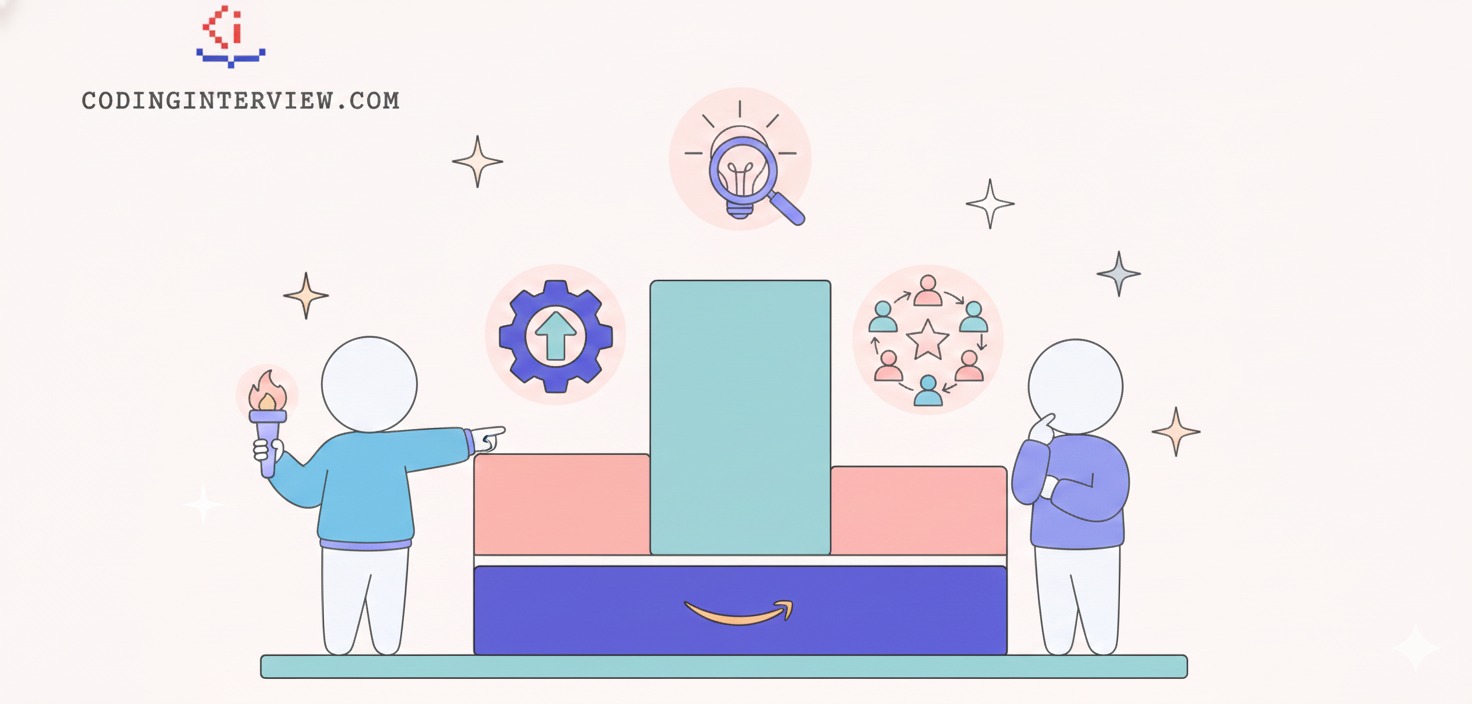
The Amazon leadership principles interview is one of the most influential parts of the hiring process, especially for technical roles. Even if you perform well in coding or system design, you cannot pass the interview loop without demonstrating strong alignment with Amazon’s leadership principles.
This interview is designed to understand how you think, communicate, make decisions, handle pressure, resolve ambiguity, and take ownership of technical challenges. For coding candidates, the LP interview is not just behavioral; it’s an evaluation of how you operate as an engineer in real scenarios: debugging outages, collaborating with cross-functional teams, delivering under deadlines, or simplifying complex systems.
This guide helps you prepare for the Amazon leadership principles interview with a coding-focused lens to boost your chances of earning the offer.
What Amazon Evaluates: The Role of Leadership Principles in Technical Hiring
The Amazon leadership principles are not abstract values; they serve as a practical evaluation framework for how you behave as a builder, collaborator, and problem solver. Amazon evaluates coding candidates on a combination of technical excellence and leadership behavior. This means that during every round, interviewers will assess not only what you solved but how you solved it.
Why Leadership Principles Matter for Engineers
Amazon SDEs and technical roles frequently work in ambiguous environments, owning services end-to-end and making decisions that impact real customers. Leadership principles help interviewers evaluate:
1. Ownership and Reliability
Can you be trusted to own a system or feature from design to maintenance?
Do you take responsibility when things break?
2. Dive Deep During Technical Problem-Solving
Do you ask clarifying questions?
Do you investigate root causes instead of making assumptions?
3. Customer Obsession in Design and Coding Decisions
Do you optimize for customer impact rather than engineering ego?
4. Bias for Action
Do you move efficiently, especially when solving coding problems under time pressure?
5. Invent and Simplify
Can you propose simpler, more scalable approaches during architecture or coding discussions?
6. Deliver Results
Do you show resilience, prioritization, and execution in complex technical situations?
Amazon hires for long-term cultural fit because engineers must make judgment calls daily, not just solve algorithmic questions.
Interview Structure: How Leadership Principles Are Tested
The Amazon leadership principles interview is not limited to one dedicated behavioral round. LPs are assessed in every part of the interview loop, coding, system design, and behavioral sessions, because Amazon views leadership and technical ability as inseparable.
1. Coding Interviews (Two Rounds)
Leadership principles surface here through your communication and process:
- Clarifying requirements (Customer Obsession)
- Explaining thought process (Dive Deep)
- Handling errors calmly (Bias for Action)
- Considering edge cases (Insist on the Highest Standards)
- Thinking aloud about trade-offs (Invent and Simplify)
Interviewers evaluate your maturity and decision-making, not just whether your code runs.
2. System Design Interview
This round tests your ability to design scalable, reliable systems. LPs show up when you:
- Frame trade-offs confidently (Dive Deep, Think Big)
- Consider customer-facing impact of latency/errors (Customer Obsession)
- Justify choices in databases, caching, durability (Ownership)
- Explain monitoring, testing, and rollback strategies (Deliver Results)
3. Dedicated Behavioral / Leadership Principles Interview
Typically led by a bar-raiser, this round goes deep into:
- Past failures
- Ambiguous situations
- Conflicts with teammates
- Large-scale ownership challenges
- Technical learnings and mistakes
Expect intense probing questions that require specifics and measurable outcomes.
4. Cultural and Leveling Evaluation
LP interviews also determine whether you’re performing at L4, L5, or senior levels based on:
- Impact of past projects
- Depth and independence of your decisions
- Communication clarity
- Complexity of ownership
Understanding how LPs weave into each round helps you prepare strategically, not just memorize stories.
Deep Dive into the Leadership Principles
Amazon expects engineers to embody the leadership principles in every technical action they take, from how they debug to how they design services. This section breaks down the principles that matter most specifically for coding and system design interviews, focusing on how to demonstrate them naturally.
Customer Obsession
For engineers, this means optimizing for users: low latency, reliability, clean interfaces, and minimal edge-case failures.
In interviews, you show this by:
- Asking clarifying questions about constraints (“What scale do we need to support?”)
- Prioritizing correctness and user impact over flashy optimization
- Mentioning real-world behavior, such as handling bad inputs or inconsistent data
Dive Deep
This is one of the strongest engineering LPs. Amazon expects you to show depth when analyzing a problem:
- Asking probing questions about input formats
- Breaking down failing test cases
- Exploring root causes systematically
- Thinking through the time and space complexity thoroughly
Invent and Simplify
Engineers should seek elegant solutions, not unnecessarily complex ones.
You demonstrate this when you:
- Propose a basic brute-force solution before optimizing
- Simplify your code structure
- Suggest a cleaner data model in system design
- Choose readable solutions over clever one-liners
Ownership
Amazon engineers own the full lifecycle—design, implementation, monitoring, and improvement.
In interviews, ownership shows when you:
- Proactively test edge cases
- Notice inconsistencies and resolve them
- Explain how you would monitor and maintain a service in system design
Bias for Action
Amazon values engineers who can move quickly and avoid analysis paralysis.
During coding interviews, this appears as:
- Starting with a clear plan
- Iterating logically
- Recovering gracefully when stuck
- Avoiding unnecessary detours
Deliver Results
Ultimately, Amazon wants people who finish things.
Demonstrate this by:
- Producing working code within the time constraints
- Communicating trade-offs clearly
- Handling errors without panicking
- Completing your thought process end-to-end
These LPs guide how Amazon evaluates coding performance, not just how you tell stories.
STAR and STARL Frameworks
Amazon’s behavioral interview is notoriously deep, and the bar-raiser will drill into every detail of your stories. Using STAR or STARL helps you structure responses so they are clear, complete, and “probe-resistant.”
Why STAR/STARL Is Essential at Amazon
Interviewers look for long-term patterns of behavior. A well-structured story helps them assess:
- How you think
- How you react to conflict or failure
- How you handle accountability
- How you measure impact
- How you learn and grow
Breakdown of the STAR/STARL Framework
Situation
Set context in 1–2 sentences.
Amazon dislikes unnecessary backstory—focus on what matters.
Task
Describe your specific responsibility, not the team’s.
Interviewers want to know what you owned.
Action
This is where you should spend most of your time.
For engineering stories, highlight:
- Technical decisions
- Design trade-offs
- Debugging steps
- Collaboration with SDEs, PMs, and data engineers
- Moments you demonstrated LPs organically
Result
Use metrics whenever possible:
- “Reduced processing time by 35%”
- “Decreased latency by 50 ms”
- “Saved 10 engineer-hours per sprint.”
Amazon values measurable results.
Learning (STARL)
This distinguishes high-bar candidates.
Show humility and reflection:
- What would you do differently?
- What did you learn about debugging, design, collaboration, or prioritization?
- How did you grow as an engineer?
How to Use STAR/STARL in Technical Interviews
- Describe a tricky bug using STARL
- Explain the design of a new feature using STARL
- Share how you resolved production issues or scaling problems
- Demonstrate how you communicated trade-offs with stakeholders
Amazon expects engineers to have 8–12 well-crafted stories that map to multiple leadership principles. STARL is the foundation for delivering them effectively.
Leadership Principles in Coding Interviews
Coding interviews at Amazon are not “just coding”; they are behavioral interviews in disguise. The interviewer is assessing how you think under pressure, how you communicate, and how you apply leadership principles to technical decision-making.
How LPs Show Up Naturally in Coding Interviews
Customer Obsession
Ask clarifying questions before coding:
- “Should we assume the input could be empty?”
- “Do we need to preserve the original order?”
- “What’s the maximum expected input size?”
These questions show you care about real-world behavior.
Dive Deep
Demonstrate depth through:
- Thorough analysis of brute-force and optimal solutions
- Enumerating edge cases proactively
- Walking through test cases step-by-step
- Explaining complexity as you go
This shows engineering maturity.
Invent and Simplify
Interviewers watch for simplicity in your approach:
- Choosing intuitive variable names
- Breaking logic into helper functions
- Avoiding unnecessary data structures
- Keeping code clear rather than clever
Simplicity is a strong positive signal.
Bias for Action
Move with intention:
- Outline your solution quickly and clearly
- Start coding once your plan is sound
- Don’t overanalyze after reaching the optimal approach
Interviewers want to see efficient execution, not rushed guessing.
Insist on the Highest Standards
Demonstrate this by:
- Writing clean, readable code
- Testing edge cases
- Verifying correctness
- Catching your own mistakes
- Improving variable naming or minor inefficiencies
Your attention to detail is part of your evaluation.
Deliver Results
Show that you can complete the task:
- Finish your solution, even if imperfect
- Communicate what you would optimize next
- Explain how you’d test and deploy this in production
- Stay calm, even if you make a mistake
Interviewers care as much about your resilience as your syntax.
Putting It All Together
A strong coding candidate at Amazon:
- Communicates clearly
- Demonstrates structured reasoning
- Shows curiosity and ownership
- Writes reliable code
- Balances speed with correctness
- Adapts when stuck
- Treats edge cases with high standards
Technical excellence is important, but leadership behavior during coding is what differentiates bar-raising candidates.
Leadership Principles in System Design Interviews
System design interviews at Amazon are not only technical—they are deeply tied to leadership principles. Amazon expects engineers to design scalable, customer-centric systems while demonstrating clarity of thought, ownership, and an ability to reason about ambiguous trade-offs.
How LPs Show Up in System Design
Customer Obsession
Great system design starts with clearly defining customer needs. This is where you show customer obsession by asking:
- “What are the latency requirements?”
- “What guarantees do customers expect?”
- “Do we optimize for reads, writes, or both?”
This ensures your design aligns with real user impact rather than engineering aesthetics.
Dive Deep
Dive Deep shows up when you thoroughly examine bottlenecks and hidden constraints:
- How does the service behave under sudden scale spikes?
- Where could queues overflow?
- What happens after a node failure?
- Which part of the data model creates hotspots?
Interviewers want to see that you explore the system beyond high-level diagrams.
Invent and Simplify
You demonstrate this by:
- Avoiding overly complex architectures
- Choosing familiar, scalable components
- Preferring simple caching or queueing solutions over unnecessary microservices
- Identifying ways to reduce operational overhead
Amazon values simplicity that scales, not complexity that impresses.
Ownership
Ownership in system design means considering:
- Monitoring
- Alerting
- Automated rollbacks
- Failure recovery
- Consistency and durability
- Deployment strategies
Candidates who discuss observability and on-call considerations stand out immediately.
Think Big
Think Big means designing systems that can evolve:
- “How would we extend this to a new region?”
- “How could this become multi-tenant?”
- “What does the next version of this system look like?”
Demonstrating long-term thinking is a strong bar-raiser signal.
What Interviewers Are Evaluating
- Thoughtful trade-offs
- Communication clarity
- Depth of reasoning under pressure
- Awareness of real-world constraints
- Ability to turn abstract problems into actionable architectures
System design becomes significantly stronger when woven with leadership principles naturally and confidently.
Preparation Strategy: Building High-Quality LP Stories
A strong preparation strategy blends two components:
- Developing polished leadership principle stories
- Learning how to connect those stories to technical situations
How to Build High-Impact Leadership Stories
1. Create a Structured Story Bank
Aim for 12–15 STARL stories, each mapped to multiple LPs.
For example:
- A debugging crisis → Dive Deep, Ownership, Deliver Results
- Refactoring a legacy system → Invent and Simplify, Highest Standards
- Launching a new feature → Ownership, Customer Obsession
- Handling production impact → Bias for Action, Deliver Results
Each story should contain metrics, technical decisions, conflict, and clear results.
2. Write Stories with Specificity
Avoid vague stories like “We improved performance.”
Instead:
“We reduced average latency from 220 ms to 95 ms by adding a request-level cache and rewriting the aggregation logic.”
Specificity builds credibility.
3. Use STARL to Withstand Bar-Raiser Probing
Bar-raisers push deep:
- “What exactly did you do?”
- “Why didn’t you choose another approach?”
- “Show me numbers.”
A highly detailed STARL structure protects you from collapsing under follow-up pressure.
Integrating LPs Into Technical Answers
Leadership principles should show up consistently in coding and design rounds.
Examples:
- When clarifying requirements → Customer Obsession
- When explaining trade-offs → Invent and Simplify
- When testing edge cases → Highest Standards
- When recovering from mistakes → Bias for Action
- When breaking down complexity → Dive Deep
- When proposing improvements → Think Big
Engineers who can blend LPs with technical thinking appear more senior, more reliable, and more hireable.
Build Practice Through Mock Interviews
- Practice coding interviews while verbalizing LPs naturally
- Conduct behavioral-only mock sessions
- Rehearse system design while highlighting trade-offs and reasoning patterns
- Have peers challenge your STARL stories with probing questions
Consistent practice builds fluency, confidence, and authenticity.
Recommended Resources for Coding + Leadership Prep
High-quality resources can accelerate your preparation significantly. This section combines coding-specific resources with those tailored for mastering leadership principles.
Coding Resources for LP Alignment
Strong coding fundamentals reinforce leadership behaviors like Dive Deep, Ownership, and Bias for Action.
1. Grokking the Coding Interview
One of the most effective pattern-based resources for Amazon coding interviews.
Why it’s valuable for LP prep:
- Helps you communicate problem-solving more clearly
- Reinforces structured reasoning and simplicity (Invent and Simplify)
- Builds confidence under time constraints (Bias for Action)
- Strengthens debugging and edge-case awareness (Dive Deep)
2. Pattern-Based DSA Resources
- Sliding window
- BFS/DFS
- Two pointers
- Merge intervals
- Priority queue patterns
These patterns reduce mental load, allowing you to demonstrate leadership principles more effectively.
Behavioral (Leadership Principles) Resources
- Grokking the Behavioral Interview
- LP breakdowns from former Amazon interviewers
- STAR/STARL story templates
- Peer mock interview groups
- YouTube channels with LP deep dives
System Design Resources
- Intro-level system design books
- Case-based design prompts
- Diagrams and architectural walkthroughs
These help demonstrate Think Big, Ownership, and Invent and Simplify.
Practice Tools
- Mock interview platforms
- Coding platforms with timed assessments
- Journaling templates for LP stories
- LP flashcards (one per principle)
If you want to further strengthen your preparation, check out these in-depth Amazon interview guides from CodingInterview.com to level up your strategy and confidence:
- Amazon Interview Guide
- Amazon Interview Process
- Amazon Coding Interview Questions
- Amazon System Design Interview Questions
With the right resources, your leadership principles interview becomes predictable and passable.
Final Tips, Frequent Mistakes, and Interview-Day Strategy
This final section focuses on how to execute with confidence, avoid pitfalls, and perform consistently across all Amazon leadership principles interview rounds.
Common Mistakes to Avoid
1. Giving Vague or Generalized Stories
Amazon interviewers reject candidates who speak in abstractions.
Be specific. Be measurable. Be personal.
2. Overfocusing on Team Achievements
Amazon wants to know what you owned, not what “we” did collectively.
3. Forgetting to Use Metrics
Quantify impact wherever possible:
- Latency reduced
- Errors resolved
- Revenue generated
- Customer-facing improvements
4. Sounding Scripted or Memorized
LP answers should be natural, not robotic. Interviewers can sense memorization immediately.
5. Not Demonstrating LPs in Coding/System Design
Many candidates think LPs apply only in behavioral interviews; they don’t.
Interviewers watch your behavior throughout the entire loop.
Interview-Day Best Practices
- Re-read your STARL stories before the interview
- Warm up with one coding problem to get into the flow
- Take notes during problem statements
- Ask clarifying questions early
- Think aloud throughout
- Remain calm under pressure—mistakes are expected
- Tie every technical reasoning step back to an LP naturally
End-of-Interview Checkpoints
Before finishing each round, ensure you’ve shown:
- Clear prioritization (Bias for Action)
- Depth and reasoning (Dive Deep)
- Customer-centric thinking (Customer Obsession)
- Trade-off awareness (Invent and Simplify)
- Ownership and follow-through (Deliver Results)
Final Encouragement
The Amazon leadership principles interview feels intimidating, but it is one of the most predictable interviews in tech. With well-structured STARL stories, strong coding fundamentals, and awareness of LP behaviors, you can communicate your value clearly and confidently. Amazon hires people who think deeply, solve problems methodically, and take ownership, even when the situation is ambiguous. With intentional preparation, you can demonstrate all of that and earn the offer.