
If you approach Atlassian interview questions the same way you would approach Google or Amazon, you are likely to feel blindsided. Atlassian interviews are not built to reward speed, memorization, or aggressive problem-solving. They are designed to reveal how you think when building software that real teams rely on every day.
Atlassian is a product company at its core. Jira, Confluence, Trello, and Bitbucket are tools engineers use under pressure, at scale, and in collaborative environments. That reality shapes the way Atlassian interviews.
Atlassian Optimizes For Thoughtful Engineers, Not Flashy Ones
During Atlassian interviews, you are rarely rewarded for rushing to code. Interviewers want to see how you reason through ambiguity, how you ask clarifying questions, and how you balance correctness with maintainability. You are expected to slow down and think like someone who will own production code long after the interview ends.
This is why many candidates who perform well in high-pressure algorithm interviews struggle with Atlassian interview questions. The evaluation criteria are fundamentally different.
Why Atlassian Interview Questions Feel More Practical
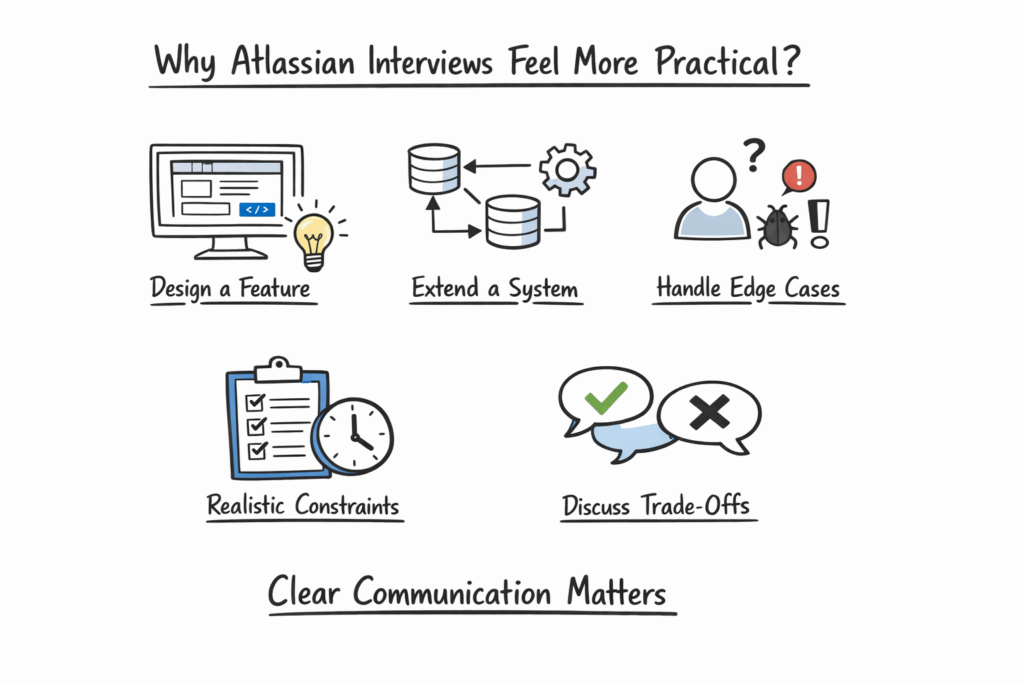
Atlassian interview questions often resemble problems you would encounter in a real engineering sprint. You might be asked to design a small feature, extend an existing system, or reason about edge cases that emerge only after users behave unexpectedly.
The focus is less on clever tricks and more on whether you can reason clearly under realistic constraints. You are being evaluated on how you communicate trade-offs, not just whether your solution passes test cases.
How Atlassian’s Remote-First Culture Shapes Interviews
Atlassian has embraced a remote-first model, and that decision directly impacts how interviews are conducted. Since you will often collaborate asynchronously with teammates across time zones, your ability to explain decisions clearly matters as much as the decisions themselves.
Interviewers pay close attention to how you articulate your thinking, how you react to feedback, and whether you can collaborate verbally while solving problems. Silence is rarely interpreted as confidence in Atlassian interviews.
Atlassian Interview Process Explained End-to-End
Understanding the structure of the Atlassian interview process removes a significant amount of uncertainty. While details vary by role and seniority, the overall flow remains consistent across teams.
Initial Recruiter Screen And What It Evaluates
Your first interaction is usually a recruiter screen. This conversation focuses on your background, role alignment, and motivation for joining Atlassian. You are not being tested technically here, but you are being evaluated for clarity, communication, and cultural alignment.
Recruiters often probe how you collaborate with others, how you handle feedback, and why Atlassian’s products and values resonate with you. Candidates who treat this as a formality often miss an opportunity to stand out early.
Technical Phone Screen Or Online Coding Round
The technical screen typically involves solving one or two coding problems in a shared editor. These Atlassian interview questions are rarely obscure, but they are intentionally open-ended.
You are expected to talk through your approach, clarify assumptions, and iterate based on feedback. Writing perfect code quickly is less important than demonstrating structured thinking and adaptability.
Onsite Or Virtual Loop Structure
The final interview loop usually includes multiple rounds conducted over a single day or spread across sessions. These rounds often include a coding interview, a system design or architecture discussion for mid to senior roles, and a behavioral or values interview.
The goal of the loop is not to trap you. It is to observe you in different problem-solving contexts and see whether your decision-making remains consistent.
Typical Atlassian Interview Loop Breakdown
| Interview Round | Primary Focus | What Interviewers Look For |
| Coding Round | Problem Solving And Communication | Clear reasoning, readable code, trade-offs |
| System Design | Architecture And Scalability | Structured thinking, real-world judgment |
| Behavioral Round | Values And Collaboration | Ownership, feedback, teamwork |
| Hiring Review | Holistic Evaluation | Signal consistency across rounds |
Atlassian Coding Interview Questions
Atlassian coding interview questions are intentionally deceptive in their simplicity. The problem statement may look familiar, but the evaluation happens in the conversation around the code, not just in the solution itself.
Communication Matters As Much As Correctness
You are expected to narrate your thought process from the moment the problem is introduced. Interviewers want to hear how you interpret requirements, identify constraints, and decide between multiple valid approaches.
If you write correct code but fail to explain why you chose a particular approach, you are leaving points on the table. Atlassian interviews reward engineers who can teach their thinking as they work.
How Atlassian Evaluates Edge Cases And Trade-Offs
You are rarely penalized for starting with a naive solution, as long as you acknowledge its limitations and improve it. Interviewers often nudge you toward discussing time complexity, space usage, and maintainability.
What matters is whether you recognize trade-offs and adjust intentionally. Blindly optimizing without explanation can hurt more than help.
Clean Code Over Clever Code
Atlassian interviewers consistently favor readability and clarity. Variable naming, logical structure, and small helper functions matter. You are writing code that someone else should be able to maintain, not code meant to impress with brevity.
This mindset mirrors how Atlassian engineers work in production, and interviewers are trained to look for it.
Common Atlassian Coding Interview Question Patterns And How To Approach Them
While Atlassian does not rely on trick questions, there are recurring patterns you should be comfortable with. These patterns test foundational problem-solving skills without requiring advanced algorithms.
Data Structure And Algorithm Patterns Atlassian Prefers
Most Atlassian coding interview questions are built around fundamental structures such as arrays, strings, hash maps, trees, and graphs. The difficulty often lies in combining these basics thoughtfully rather than applying a single textbook pattern.
You are expected to choose appropriate data structures and justify why they fit the problem’s constraints.
Common Patterns And How They Are Used
| Pattern Type | Why Atlassian Uses It | What You Should Emphasize |
| Arrays And Strings | Simulate real feature logic | Boundary handling and clarity |
| Hash Maps | Efficient lookups and grouping | Correctness and memory trade-offs |
| Trees | Hierarchical data modeling | Traversal reasoning |
| Graphs | Dependency or workflow modeling | Simplification and assumptions |
| Dynamic Programming | Optimization scenarios | Problem decomposition |
How Variations Make Atlassian Questions Harder
Atlassian interviewers often introduce follow-up constraints after you present an initial solution. These changes test whether your design is flexible or brittle. You might be asked to support additional features, handle larger input sizes, or modify assumptions.
Your response to these changes matters more than the original solution. Calmly adapting your approach demonstrates senior-level thinking.
The Right Mental Model For Atlassian Coding Rounds
Instead of treating the interview like an exam, treat it like a collaborative design discussion with code as the medium. Ask questions. Confirm assumptions. Pause to think. Atlassian interviews reward engineers who are comfortable working through uncertainty in real time.
Atlassian System Design Interview Questions For Mid And Senior Roles
If you are interviewing for a mid-level or senior role, Atlassian system design interview questions are where the interview truly differentiates candidates. These rounds are not about drawing perfect diagrams. They are about understanding how you reason about software that must evolve, scale, and remain usable by thousands of teams.
What Atlassian Expects From A System Design Discussion
Atlassian system design interviews prioritize clarity over complexity. You are expected to define the problem clearly, identify core use cases, and reason about trade-offs without getting lost in unnecessary detail.
Interviewers want to see how you decompose a large problem into manageable components and how you explain your decisions along the way. You are not expected to memorize architectures, but you are expected to justify every major choice.
Common Atlassian System Design Question Themes
Atlassian interview questions at this stage often revolve around collaboration-heavy products. You may be asked to design systems similar to issue trackers, notification pipelines, real-time collaboration tools, or permission-based content systems.
These problems intentionally mirror Atlassian’s own products, which means real-world constraints matter. Latency, consistency, auditability, and user experience are all part of the discussion.
Typical System Design Focus Areas
| Design Area | Why It Matters At Atlassian | What Interviewers Evaluate |
| API Design | Product extensibility | Clarity and versioning |
| Data Modeling | Complex workflows | Correct relationships |
| Scalability | Global user base | Thoughtful growth planning |
| Reliability | Team productivity | Failure handling |
| Observability | Debugging at scale | Monitoring strategies |
How Trade-Offs Are Evaluated In Atlassian System Design Interviews
You are expected to articulate trade-offs clearly. Choosing eventual consistency over strong consistency is acceptable if you can explain why. Selecting a simpler architecture over a highly optimized one can be a strong decision if it aligns with the expected load.
Atlassian interviewers listen carefully for intent. They want to know whether you are making choices deliberately or defaulting to patterns you have seen elsewhere.
Handling Ambiguity During The Design Discussion
Ambiguity is not a trick at Atlassian. It is part of the test. Interviewers intentionally leave requirements vague to see how you scope the problem. Strong candidates pause, ask clarifying questions, and confirm assumptions before designing anything.
This behavior signals that you will behave responsibly in production environments where requirements are rarely complete.
Atlassian Behavioral Interview Questions
Atlassian takes behavioral interviews seriously, often more seriously than candidates expect. Atlassian interview questions in this round are designed to reveal how you work with others, not how well you rehearse answers.
Why Atlassian Values Behavioral Interviews So Highly
Atlassian’s culture is built around collaboration, transparency, and ownership. Behavioral interviews are used to assess whether you will thrive in an environment where engineers are trusted to make decisions and held accountable for outcomes.
Technical excellence alone is not enough. Interviewers look for evidence that you can collaborate, communicate, and grow with a team.
Atlassian Values And How They Show Up In Interviews
While Atlassian does not expect you to recite its values, your stories should naturally align with them. Interviewers listen for signals such as how you handle disagreement, how you respond to failure, and how you support teammates.
Your examples should demonstrate reflection and growth rather than perfection.
How To Structure Behavioral Answers For Atlassian
Atlassian interview questions in behavioral rounds often start broadly. You might be asked about a conflict, a failure, or a difficult decision. What matters is how you frame the situation and what you learned from it.
Strong answers focus on context, decision-making, and outcome. Weak answers focus on blame, vagueness, or surface-level success.
Common Atlassian Behavioral Question Themes
| Question Theme | What It Reveals | What To Emphasize |
| Conflict | Collaboration style | Listening and compromise |
| Failure | Ownership | Accountability and learning |
| Feedback | Growth mindset | Adaptability |
| Ambiguity | Decision-making | Structured thinking |
Most Common Atlassian Behavioral Interview Questions
Atlassian behavioral interview questions are designed to feel conversational, but they are carefully calibrated. Each question probes how you behave when there is no obvious right answer.
Navigating Questions About Team Conflict
When asked about disagreement with a teammate, Atlassian interviewers want to hear how you navigated tension without damaging trust. You are expected to demonstrate empathy, communication, and a willingness to adjust your perspective.
Answers that focus on winning arguments tend to backfire. Answers that focus on shared outcomes tend to resonate.
Discussing Failure Without Undermining Yourself
Failure-related Atlassian interview questions are not traps. They are opportunities to demonstrate maturity. Interviewers want to see whether you can take responsibility, reflect honestly, and improve your process.
Avoid stories where the failure feels superficial or where blame is shifted elsewhere. The lesson matters more than the mistake.
Answering Questions About Ambiguity And Decision-Making
You may be asked how you handle incomplete requirements or unclear goals. Atlassian values engineers who can move forward responsibly even when information is missing.
Strong answers describe how you gather context, involve stakeholders, and iterate as you learn more. This mirrors how product development actually works at Atlassian.
Atlassian Frontend And Backend Interview Questions
Atlassian interview questions vary based on role, but the evaluation philosophy remains consistent. Whether you are interviewing for a frontend or backend position, you are expected to demonstrate practical engineering judgment.
Atlassian Frontend Interview Questions And What They Emphasize
Frontend interviews at Atlassian focus on building maintainable, accessible, and performant user experiences. You may be asked to reason about state management, component design, or performance bottlenecks.
Interviewers care deeply about how you structure UI logic and how you think about long-term maintainability. Visual polish matters less than architectural clarity.
Frontend Evaluation Focus Areas
| Area | Why It Matters | What Interviewers Look For |
| JavaScript Fundamentals | Core reliability | Clear mental models |
| State Management | App scalability | Predictable data flow |
| Performance | User experience | Measured optimizations |
| Accessibility | Inclusive design | Awareness and intent |
Atlassian Backend Interview Questions And What They Emphasize
Backend interviews often explore API design, data modeling, and system behavior under load. You may be asked to design services, handle concurrency, or debug production-like issues.
The emphasis is on building systems that are easy to evolve and debug rather than systems that are theoretically perfect.
Backend Evaluation Focus Areas
| Area | Why It Matters | What Interviewers Look For |
| API Design | Product integration | Simplicity and clarity |
| Data Modeling | Feature correctness | Logical structure |
| Concurrency | System safety | Risk awareness |
| Observability | Production readiness | Debugging mindset |
How Role-Specific Questions Still Tie Back To Core Atlassian Values
Regardless of role, Atlassian interview questions always circle back to the same themes. Can you communicate clearly? Can you collaborate effectively? Can you make thoughtful trade-offs under real constraints?
Candidates who understand this throughline tend to perform better across all rounds.
Atlassian Backend Interview Questions Deep Dive For Backend Engineers
Backend-focused Atlassian interview questions are designed to reveal how you think about real production systems, not how well you recall theoretical concepts. You are evaluated on your ability to build services that other teams can rely on, extend, and debug without friction.
API Design And Service Boundaries
Atlassian interviewers often begin backend discussions by asking how you would expose functionality to other services or clients. You are expected to think carefully about API contracts, versioning, and backward compatibility.
What matters most is whether your APIs are intuitive and resilient to change. Interviewers look for engineers who anticipate evolution rather than locking systems into rigid designs.
Data Modeling And Storage Decisions
Data modeling is a recurring theme in Atlassian backend interview questions. You may be asked to design schemas, choose storage technologies, or reason about relationships between entities.
Your explanation should focus on why a particular model supports the product’s workflow and how it adapts as features grow. Perfect normalization is less important than practical usability and performance.
Concurrency And Reliability In Real Systems
Atlassian products are used by teams simultaneously, which makes concurrency and reliability unavoidable topics. Interviewers want to see whether you understand race conditions, idempotency, and failure scenarios.
You are not expected to eliminate every failure. You are expected to design systems that fail predictably and recover gracefully.
Backend System Evaluation Criteria
| Backend Focus Area | Why Atlassian Cares | What Signals Strong Performance |
| API Contracts | Ecosystem stability | Clear interfaces |
| Data Consistency | Workflow correctness | Thoughtful guarantees |
| Concurrency | User trust | Safe assumptions |
| Failure Handling | System resilience | Graceful degradation |
Mistakes Candidates Make When Preparing For Atlassian Interviews
Many candidates fail Atlassian interviews not because they lack skill, but because they prepare using the wrong mental model. Atlassian interview questions punish shallow preparation and reward thoughtful, adaptable engineers.
Treating Atlassian Like A Speed Coding Interview
Rushing through problems without clarifying requirements is one of the most common mistakes. Atlassian interviewers expect you to slow down, ask questions, and think aloud.
Silence is rarely interpreted positively. Talking through uncertainty shows maturity.
Over-Memorizing Patterns Without Understanding Trade-Offs
Memorizing solutions without understanding why they work often leads to rigid thinking. Atlassian interview questions frequently include follow-up constraints that invalidate canned approaches.
Interviewers look for flexibility, not recall.
Ignoring Behavioral Preparation Entirely
Candidates often underestimate the importance of behavioral interviews at Atlassian. Weak or vague stories can overshadow strong technical performance.
Your ability to reflect honestly on past experiences matters more than presenting flawless outcomes.
Writing Code Without Considering Maintainability
Code that is correct but difficult to read or extend sends the wrong signal. Atlassian values engineers who think beyond the immediate task and consider long-term ownership.
How To Prepare For Atlassian Interview Questions: A Realistic 6 To 8 Week Plan
Preparing effectively for Atlassian interview questions requires structure and intention. A focused plan allows you to build confidence without burning out.
Weeks One And Two: Building Foundations
During the first phase, you should focus on strengthening core data structures, problem-solving patterns, and communication habits. This is where you practice explaining solutions clearly rather than optimizing for speed.
You should also begin reflecting on past projects to identify stories that demonstrate ownership, collaboration, and learning.
Weeks Three And Four: Deepening Technical Judgment
This phase is about depth. You should practice problems that require trade-offs and extensions. System design preparation should begin here, even if you are early in your career.
Mock interviews become valuable at this stage, especially those that simulate conversation rather than silent coding.
Weeks Five And Six: Refinement And Feedback
In the final stretch, your goal is refinement. Focus on consistency, clarity, and confidence. Review common Atlassian interview questions and practice articulating decisions without rambling.
This is also the time to rehearse behavioral stories and ensure they align naturally with Atlassian’s values.
Preparation Focus By Phase
| Preparation Phase | Primary Goal | What To Emphasize |
| Weeks 1–2 | Fundamentals | Clear thinking |
| Weeks 3–4 | Depth | Trade-offs |
| Weeks 5–6 | Polish | Confidence |
| Weeks 7–8 | Optional Buffer | Mock interviews |
Structured learning and interview prep resources
A patterns-based resource like Grokking the Coding Interview Patterns reinforces the thinking Atlassian wants: clear logic, reusable problem-solving frameworks, and careful reasoning.
Final Checklist: Are You Ready For Atlassian Interviews
Before walking into your Atlassian interview, you should pause and assess your readiness honestly. Atlassian interview questions reward self-awareness as much as technical skill.
You should feel comfortable explaining your code out loud, defending design decisions, and adapting when requirements change. You should be able to discuss failures without deflecting blame and describe collaboration without exaggeration.
Confidence at Atlassian does not come from knowing everything. It comes from knowing how you think and being able to share that clearly.
Final Thoughts
Atlassian interview questions are designed to surface engineers who think deeply, communicate clearly, and collaborate thoughtfully. The interview is not a performance. It is a working session.
If you approach Atlassian interviews as conversations rather than exams, your preparation changes. You focus less on memorization and more on judgment. You focus less on speed and more on clarity.
That mindset shift is what separates candidates who feel overwhelmed from those who walk away knowing they presented their best selves.
When you prepare with intention and practice explaining your thinking, you are no longer just preparing for an interview. You are preparing to work like an Atlassian engineer.