

If you prepare for Citadel interview questions the same way you prepare for FAANG interviews, you will likely be caught off guard. Citadel interviews are not optimized for comfort, culture fit, storytelling, or gradual problem-solving. They are optimized for performance.
Citadel operates in a world where milliseconds matter, correctness is non-negotiable, and mistakes have measurable financial consequences. That reality shapes how candidates are evaluated.
Citadel Is A Performance-First Engineering Environment
At Citadel, engineering exists to support trading, research, and risk management systems that run continuously under extreme pressure. Interviews reflect this environment. You are expected to demonstrate precision, speed, and depth simultaneously.
Unlike many SaaS companies, Citadel does not prioritize consensus-driven design discussions during interviews. Instead, interviewers want to see whether you can arrive at a correct, efficient solution quickly and defend it with confidence.
Why Citadel Interview Questions Feel Intimidating
Citadel interview questions often feel harder than expected, not because the problems are obscure, but because the margin for error is small. Partial solutions, vague reasoning, or untested assumptions are quickly exposed.
Interviewers are trained to challenge your logic directly. This is not hostility. It is a simulation. Citadel wants engineers who can operate under scrutiny without losing composure.
How Citadel Interviews Differ From FAANG Interviews
FAANG interviews often reward structured exploration and collaboration. Citadel interviews reward decisiveness and accuracy. You are expected to think independently, validate your approach, and move forward without excessive prompting.
This difference is critical. Candidates who wait for hints or reassurance often struggle.
Citadel Interview Process Explained End-to-End
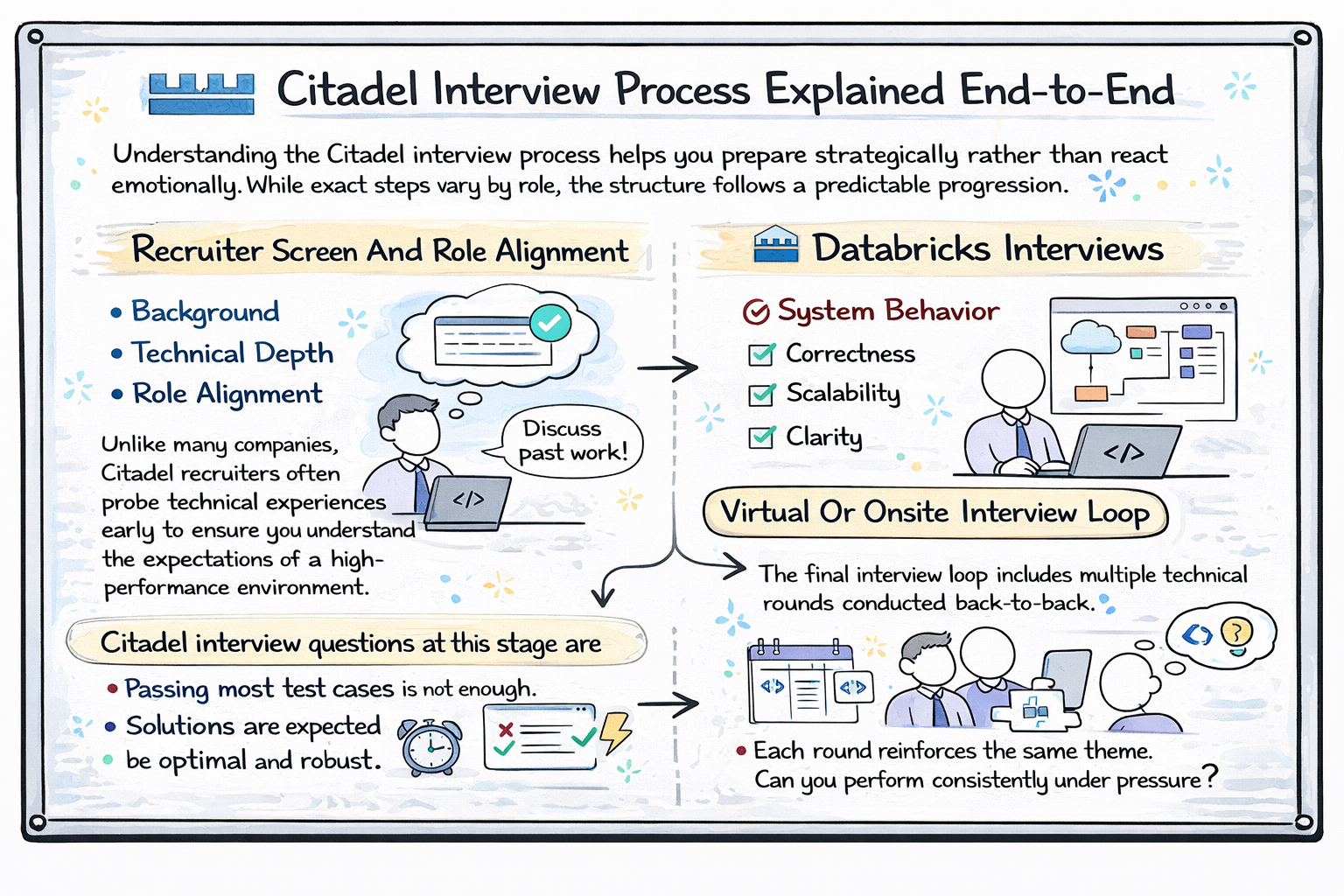
Understanding the Citadel interview process helps you prepare strategically rather than react emotionally. While exact steps vary by role, the structure follows a predictable progression.
Recruiter Screen And Role Alignment
The recruiter screen focuses on your background, technical depth, and role alignment. Unlike many companies, Citadel recruiters often probe technical experiences early to ensure you understand the expectations of a high-performance environment.
You should be prepared to discuss past work with specificity and confidence. Vague descriptions signal misalignment.
Online Assessments And Technical Screens
Many candidates encounter an online coding assessment early in the process. These assessments are designed to test correctness, efficiency, and edge-case handling under time pressure.
Citadel interview questions at this stage are intentionally unforgiving. Passing most test cases is not enough. Solutions are expected to be optimal and robust.
Virtual Or Onsite Interview Loop
The final interview loop includes multiple technical rounds conducted back-to-back. These often include deep coding interviews, system or low-level design discussions, and targeted behavioral evaluation.
Each round reinforces the same theme. Can you perform consistently under pressure?
Typical Citadel Interview Loop Structure
| Interview Stage | Primary Focus | Evaluation Emphasis |
| Recruiter Screen | Role Fit | Clarity and alignment |
| Online Assessment | Coding Performance | Correctness and speed |
| Technical Rounds | Problem Solving | Depth and efficiency |
| Design Round | System Thinking | Constraints and rigor |
| Behavioral Round | Accountability | Ownership and judgment |
What Citadel Is Really Testing In Coding Interview Questions
Citadel coding interview questions are not puzzles. They are stress tests. Every question is designed to reveal how you behave when precision and time pressure collide.
Correctness Comes Before Everything Else
At Citadel, a solution that fails on edge cases is not considered partially correct. It is incorrect. Interviewers expect you to validate assumptions, test boundaries mentally, and reason through failure modes before declaring a solution complete.
This expectation reflects production reality. In trading systems, incorrect behavior is unacceptable regardless of intent.
Why Time And Space Complexity Matter More Here
Citadel interview questions place unusually strong emphasis on efficiency. Interviewers expect you to analyze complexity naturally and optimize without being prompted.
Choosing a slower approach and hoping to improve it later is risky. You are expected to identify the optimal strategy early and justify it clearly.
How Interviewers Evaluate Your Thought Process
Interviewers listen carefully to how you reason through constraints. Silence without progress is concerning. Talking without precision is worse.
Strong candidates verbalize assumptions, confirm constraints, and move decisively. Hesitation signals uncertainty. Over-explaining signals a lack of confidence.
Common Citadel Coding Interview Questions
Citadel interview questions often use familiar algorithmic foundations, but they are rarely presented in a forgiving way. The challenge lies in execution, not recognition.
Core Algorithmic Areas Citadel Focuses On
Most Citadel coding interviews draw from arrays, strings, graphs, dynamic programming, and math-heavy logic. However, problems are often layered with constraints that invalidate naive solutions.
You are expected to handle large input sizes, tight memory limits, and worst-case scenarios from the start.
How Citadel Increases Difficulty Without Obscurity
Instead of obscure tricks, Citadel increases difficulty by tightening constraints. Time limits are strict. Inputs are large. Edge cases are subtle.
This forces you to think like an engineer building systems that must perform reliably under load.
Common Patterns And Evaluation Focus
| Pattern Type | How It Appears At Citadel | What You Are Evaluated On |
| Arrays And Strings | Large-scale inputs | Boundary correctness |
| Graphs | Dependency modeling | Optimal traversal |
| Dynamic Programming | Constrained optimization | State clarity |
| Math-Based Logic | Precision tasks | Numerical accuracy |
The Right Mental Model For Citadel Coding Interviews
You should approach Citadel interview questions like production incidents, not classroom exercises. Validate assumptions early. Test edge cases mentally. Optimize deliberately.
Citadel is not looking for perfection. It is looking for engineers who minimize risk under pressure.
Citadel System Design Interview Questions
Citadel system design interview questions are fundamentally different from those at consumer tech companies. These interviews are not about brainstorming features or exploring multiple architectural styles. They are about designing systems that must operate correctly under extreme constraints.
What Citadel Expects From A System Design Discussion
You are expected to start with clear assumptions and quickly narrow the scope. Open-ended exploration without direction signals uncertainty. Citadel interviewers want to see whether you can impose structure on ambiguous problems.
The discussion moves quickly from requirements to constraints. Latency budgets, throughput targets, and failure scenarios are not optional details. They are central to the design.
Low Latency And Deterministic Behavior As Core Themes
Most Citadel system design interview questions revolve around minimizing latency and maximizing predictability. Systems are expected to behave consistently under load, even if that means sacrificing flexibility.
You should be comfortable discussing synchronous versus asynchronous communication, in-memory processing, and minimizing network hops. Every design choice should be tied back to measurable performance outcomes.
Reliability And Failure Handling In Trading Infrastructure
Failure is inevitable in distributed systems, but at Citadel, failure must be contained. Interviewers want to see whether you think proactively about failure modes and recovery strategies.
Designs that rely on manual intervention or delayed consistency are often challenged. You are expected to plan for automatic recovery and predictable degradation.
System Design Evaluation Focus
| Design Dimension | Why It Matters At Citadel | What Interviewers Listen For |
| Latency | Competitive advantage | Deterministic paths |
| Throughput | Market volume | Capacity planning |
| Reliability | Financial risk | Failure isolation |
| Observability | Debug speed | Actionable metrics |
How Citadel Evaluates Trade-Offs Under Extreme Constraints
Trade-offs are unavoidable in system design, but Citadel interviewers evaluate them differently from most companies. Choosing the wrong trade-off is often worse than choosing no trade-off at all.
Latency Versus Reliability Decisions
At Citadel, latency is often prioritized, but never blindly. Interviewers want to see whether you understand when to sacrifice durability for speed and when correctness must dominate.
You should be able to articulate why a decision is acceptable in one context and unacceptable in another. Hand-waving trade-offs without grounding them in system behavior is a red flag.
Memory Versus Speed Trade-Offs
Citadel interview questions frequently explore whether you understand memory hierarchy and cache behavior. In-memory solutions are common, but memory is not infinite.
You are expected to justify memory usage explicitly and understand how it impacts garbage collection, cache locality, and performance predictability.
When Optimization Is Mandatory And When It Is Premature
One of the hardest aspects of Citadel interviews is knowing when optimization is required immediately. Unlike many environments, Citadel often expects optimized solutions from the start.
Interviewers may challenge you directly if your approach introduces avoidable overhead. Strong candidates anticipate these challenges and address them proactively.
Citadel Behavioral Interview Questions
Citadel behavioral interview questions are blunt by design. These interviews are not about cultural storytelling or value alignment narratives. They are about accountability and performance under pressure.
Why Citadel Behavioral Interviews Feel Different
Citadel operates in an environment where individual decisions can have an outsized impact. Behavioral interviews are used to assess whether you take responsibility seriously and whether you can operate independently.
Interviewers often ask direct questions and expect direct answers. Overly polished or vague responses tend to raise concern.
How Ownership Is Evaluated At Citadel
Ownership at Citadel means standing behind decisions, especially when outcomes are unfavorable. Interviewers want to hear about situations where you made hard calls and accepted the consequences.
Stories that emphasize shared blame or external factors often fall flat. What matters is how you responded and what you changed afterward.
Handling Failure In A High-Stakes Environment
When discussing failure, Citadel interviewers listen for precision. What exactly went wrong? What signals were missed? What corrective action was taken?
Emotional framing matters less than analytical clarity. You are expected to treat failure as a system to debug, not a personal narrative to soften.
Behavioral Evaluation Themes
| Theme | What It Reveals | What Strong Answers Demonstrate |
| Pressure | Stress tolerance | Composure |
| Failure | Accountability | Learning loops |
| Disagreement | Independence | Conviction with openness |
| Speed | Judgment | Prioritization |
Citadel Backend Interview Questions
Citadel backend interview questions probe deep into your understanding of how systems behave at the lowest levels. These interviews are unapologetically technical.
Concurrency And Multithreading Under Load
You should expect questions about concurrent systems, locking strategies, and race conditions. Citadel interviewers often explore how you reason about shared state and thread safety.
Conceptual understanding is not enough. You must demonstrate how these concerns affect real code and system behavior.
Memory Management And Performance Predictability
Memory management is a recurring theme in Citadel interviews. Interviewers want to know whether you understand allocation patterns, garbage collection impact, and memory fragmentation.
You are expected to reason about how memory behavior affects latency and tail performance, not just average performance.
Debugging And Profiling In Production-Like Scenarios
Citadel interview questions often include debugging scenarios that simulate production incidents. You may be asked how you would identify a performance regression or isolate a failure.
Strong answers focus on hypothesis-driven debugging and efficient use of observability tools.
Backend Evaluation Focus Areas
| Backend Area | Why It Matters At Citadel | What Interviewers Evaluate |
| Concurrency | System safety | Correct synchronization |
| Memory | Performance stability | Predictable behavior |
| Networking | Data flow | Latency awareness |
| Debugging | Incident response | Diagnostic rigor |
How Backend Interviews Reflect The Actual Job
Citadel backend interviews are not academic exercises. They are simulations of the decisions you will make in production environments where speed and correctness are inseparable.
Candidates who approach these interviews with a mindset of precision, accountability, and technical depth tend to stand out.
Mistakes Candidates Make When Preparing For Citadel Interviews
Many candidates underestimate Citadel interview questions because they assume difficulty comes from obscure algorithms. In reality, most failures happen because of mindset and preparation gaps rather than a lack of intelligence.
Treating Citadel Like A Typical Big Tech Interview
One of the most common mistakes is approaching Citadel interviews with a collaborative, exploratory mindset designed for FAANG-style interviews. At Citadel, interviewers expect decisiveness. Excessive hesitation, repeated confirmation seeking, or waiting for hints signals uncertainty.
You are expected to drive the solution forward with confidence once constraints are clear.
Ignoring Performance And Edge Cases
Correctness at the small scale is not sufficient. Citadel interview questions almost always assume worst-case inputs. Candidates who fail to address overflow, precision loss, or memory limits early often lose credibility quickly.
Interviewers expect you to think defensively from the start.
Writing Code Without Validating Assumptions
Another frequent mistake is writing code based on unverified assumptions. Citadel interviewers intentionally leave details unstated to see whether you ask the right questions.
Failing to validate assumptions before coding often leads to flawed solutions, even if the logic appears sound.
Over-Indexing On Behavioral Storytelling
Overly polished behavioral answers can feel inauthentic at Citadel. Interviewers prefer concise, fact-driven explanations of what happened, what broke, and what changed.
Stories that focus more on emotions than decisions tend to miss the mark.
How To Prepare For Citadel Interview Questions: A 6 To 8 Week Plan
Preparing for Citadel interview questions requires intensity and structure. Casual preparation rarely works. A deliberate plan allows you to build the precision and speed Citadel expects.
Weeks One And Two: Reinforcing Core Algorithmic Foundations
The early phase should focus on strengthening fundamentals. Arrays, graphs, dynamic programming, and math-heavy problems should be practiced with an emphasis on correctness and complexity analysis.
You should practice under time constraints to simulate interview pressure. Slow correctness is not enough.
Weeks Three And Four: Optimizing For Speed And Accuracy
At this stage, your focus should shift toward optimization. You should aim to identify optimal solutions quickly and articulate why they are optimal.
Timed mock interviews become critical here. Practicing live problem-solving with feedback reveals hesitation patterns that solo practice hides.
Weeks Five And Six: Stress Testing And Refinement
The final phase is about consistency. You should be able to perform well across multiple problem types without mental fatigue.
Behavioral preparation should focus on clarity and accountability rather than storytelling. Practice concise explanations that highlight decision-making.
Preparation Focus By Phase
| Preparation Phase | Primary Objective | Key Skill Developed |
| Weeks 1–2 | Fundamentals | Correctness |
| Weeks 3–4 | Optimization | Speed |
| Weeks 5–6 | Consistency | Confidence |
| Weeks 7–8 | Optional Buffer | Mock performance |
Final Checklist Before Your Citadel Interview
Before entering your Citadel interview, you should assess your readiness honestly. Citadel interview questions expose gaps quickly.
You should feel comfortable reasoning through problems under time pressure without freezing. You should be able to explain why your solution is correct, not just how it works. You should expect direct challenges and remain composed when they occur.
If you hesitate when discussing complexity, trade-offs, or failure scenarios, additional preparation is needed.
Confidence Without Arrogance
Citadel interviewers respect confidence grounded in reasoning. Overconfidence without validation is risky. Strong candidates strike a balance between decisiveness and openness to correction.
What Success In Citadel Interviews Actually Looks Like
Success at Citadel is not about brilliance in isolation. It is about reliable performance under pressure.
Interviewers are looking for engineers who can operate independently, minimize risk, and deliver correct solutions quickly. You do not need to be perfect. You need to be precise.
Candidates who internalize this distinction often feel calmer during interviews because expectations are clear.
Structured learning and interview prep resources
A patterns-based resource like Grokking the Coding Interview Patterns reinforces the thinking Citadel wants: clear logic, reusable problem-solving frameworks, and careful reasoning.
Final Thoughts
Citadel interview questions are designed to simulate the environment you would work in every day. Precision matters. Speed matters. Accountability matters.
If you prepare with the goal of being correct under pressure rather than impressive on paper, your approach changes. You practice validating assumptions. You optimize deliberately. You speak with clarity.
That shift is what separates candidates who struggle from those who perform confidently.
Citadel interviews are demanding by design. When you prepare intentionally and honestly, they become manageable. And when they become manageable, they become an opportunity rather than an obstacle.