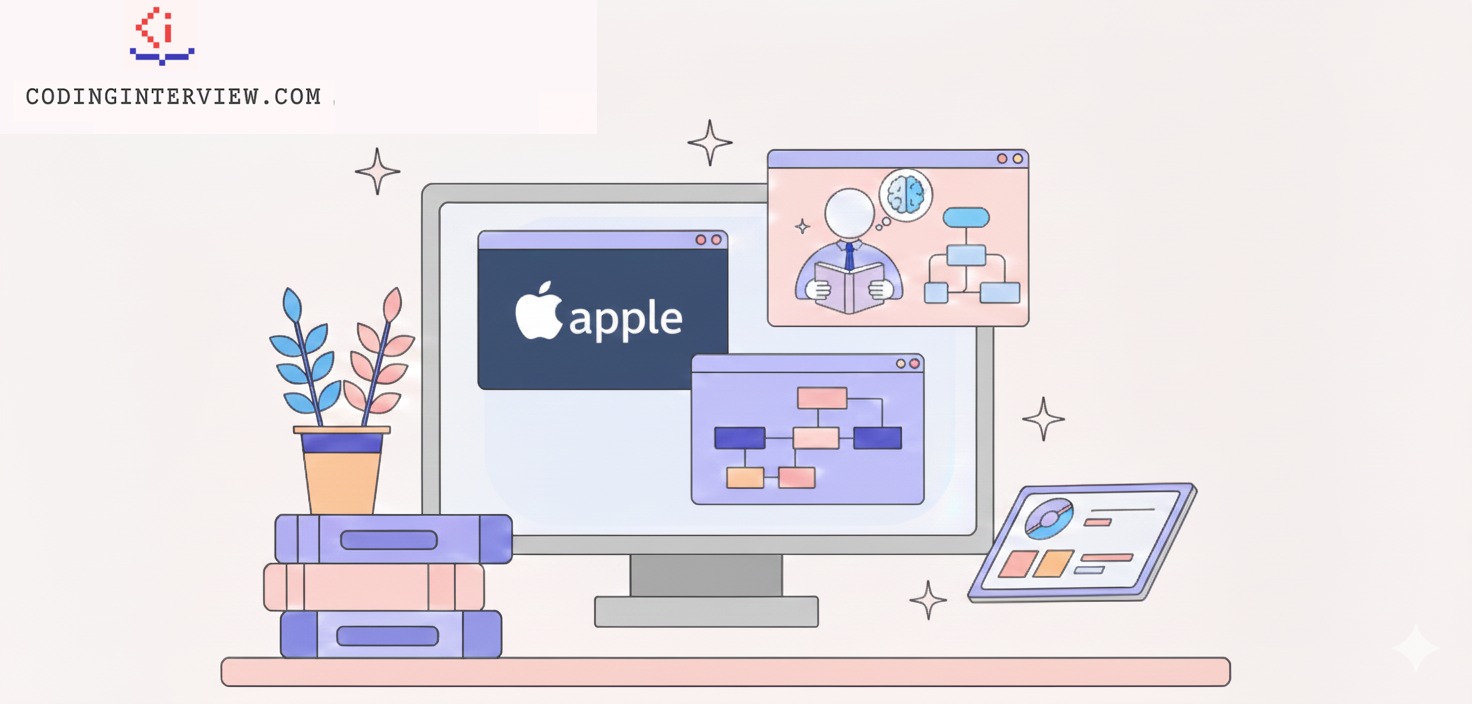
Preparing for a coding role at Apple requires mastery of problem-solving, strong fundamentals, and a clear communication style. Apple interviews often emphasize depth over speed, so choosing the right study materials makes a significant difference. In this guide, you will find the 5 best resources to prepare Apple coding interview workflows, what each resource offers, and how to use them effectively.
Whether you are preparing for the initial technical screen, the collaborative coding round, or the deeper algorithmic interviews, these resources will help you build confidence and clarity.
1. Grokking the Coding Interview Patterns for Coding Questions
Apple often expects candidates to demonstrate mastery of common algorithmic patterns, including graph traversal, recursion, backtracking, sliding window, and dynamic programming. This course is an excellent foundation because it breaks these concepts into repeatable patterns.
How to use it:
- Work through each pattern module in sequence.
- After completing a pattern, solve two or three fresh problems aligned to that concept.
- Focus on clarity: Apple interviewers evaluate how you reason, not just whether you derive the correct answer.
Why it stands out: Apple engineers value structured problem-solving. This resource helps you build the reasoning frameworks you will need during interactive coding rounds.
2. Apple Coding Interview Guide
This guide outlines Apple’s interview structure, common problem categories, communication expectations, and topic frequency. It also explains the collaborative approach Apple uses, where candidates work with the interviewer to refine solutions.
How to use it:
- Read the sections outlining Apple’s two-part technical screen.
- Review the most common question types: arrays, graphs, recursion, and dynamic programming.
- Focus on the sections explaining collaborative coding—they are key to Apple’s style.
Why it stands out: Apple interview cycles are unique in their emphasis on iteration and dialogue. This guide helps you understand those expectations before you begin practicing.
3. Grokking the Coding Interview Patterns repo by dipjul
This open-source repository complements Resource 1 by providing alternative solutions, community commentary, and additional variations of pattern-based problems.
How to use it:
- Pick one problem from the repo weekly and attempt it without hints.
- Compare your solution to the community’s approaches; note alternative strategies.
- Track which patterns you revisit most—the repetition will sharpen your intuition.
Why it stands out: Seeing how multiple engineers approach the same problem prepares you for Apple’s conversational problem-solving style.
4. AlgoExpert Coding Interview Course
AlgoExpert offers well-structured video explanations for problems across difficulty levels. Apple interviews often involve deeper algorithmic questions that require careful communication, and AlgoExpert’s walkthroughs reinforce this style.
How to use it:
- Start with the “medium” problems to align with Apple’s baseline difficulty.
- Watch solution videos to understand the thought process, not just the code.
- Time your sessions to build comfort with Apple’s pace and conversational flow.
Why it stands out: AlgoExpert’s emphasis on clear reasoning mirrors Apple’s evaluation criteria. The structured explanations help you refine your articulation alongside your coding skills.
5. LeetCode Premium
LeetCode Premium offers a curated list of coding interview problems gathered from real candidate reports. The problem set covers common question areas, such as recursion, graphs, string manipulation, and dynamic programming—core topics in Apple interviews.
How to use it:
- Work through the tagged question list in increasing difficulty.
- Solve problems in timed sets to prepare for Apple’s technical screen.
- Study discussion threads to compare strategies and learn alternate approaches.
Why it stands out: Apple’s problem difficulty and patterns are well-represented in LeetCode’s question list, making it a reliable benchmark for readiness.
How to stitch these resources into a prep plan
Here is a recommended six-week study plan:
| Week | Focus |
| Week one | Complete four pattern modules from Resource 1; skim Resource 2 for Apple-specific expectations. |
| Week two | Solve ten to fifteen problems, comparing your approach using Resource 3. |
| Week three | Begin Resource 4; focus on communication and clarity during problem walkthroughs. |
| Week four | Use Resource 5 to drill Apple-tagged problems; complete two timed sessions. |
| Week five | Simulate a full technical screen—ninety minutes, two rounds; perform a post-mortem using Resources 2 and 3. |
| Week six | Refine weak patterns using Resources 1–3; complete three timed practice blocks from Resource 5; prepare interview mindset. |
Final tips
- Clarify assumptions early: Apple interviewers appreciate thoughtful, structured discussion.
- Communicate proactively: Explain tradeoffs, edge cases, and alternative paths.
- Prioritize readability: Apple values clean, maintainable code.
- Practice recursion and graph problems—they appear frequently.
- Treat each mock session as a data point: refine your approach after every attempt.
With these five resources and a structured plan, you’ll be well-prepared to approach the Apple coding interview with confidence.
Happy learning!
Related Videos