Securing a role at LinkedIn requires more than strong technical fundamentals—it requires proving your ability to build systems that connect, scale, and deliver real value to millions of professionals around the globe. As a leader in professional networking and data-driven platforms, LinkedIn values engineers who write clean, efficient code and think critically about performance, reliability, and user experience.

LinkedIn coding interview questions
LinkedIn’s technical interviews are crafted to assess your core programming skills, algorithmic thinking, and problem-solving capabilities. These rounds often include questions about data structures, algorithms, and practical scenarios that test your ability to write clean, optimized, scalable code. You can expect problems involving arrays, hash maps, heaps, trees, and sliding windows, along with occasional challenges reflecting LinkedIn’s real-world scale and complexity.
Let’s dive into a few examples of questions typically seen in LinkedIn interviews.
1. Valid parentheses
Problem statement: Given a string containing just the characters '(', ')', '{', '}', '[', and ']', determine if the input string is valid. An input string is valid if:
- Open brackets are closed by the same type of brackets.
- Open brackets are closed in the correct order.
Solution: We use a stack to track opening brackets. For every closing bracket we encounter, we check if the top of the stack contains the corresponding opening bracket. If it does, we pop it; if it doesn’t, the string is invalid. At the end, the stack must be empty for the input to be valid.
Valid parentheses
Code explanation:
- Line 2: We initialize an empty stack to track opening brackets.
- Line 3: We define a dictionary,
mapping, that maps each closing bracket to its corresponding opening bracket. - Line 5: We iterate through each character in the input string
s.- Line 6: If the character is a closing bracket (i.e., it’s in the
mappingdictionary):- Line 7: We pop the top element from the stack if it’s not empty; otherwise, we assign a placeholder value (
'#'). - Lines 8–9: We compare the popped element with the expected opening bracket; if they don’t match, return
False.
- Line 7: We pop the top element from the stack if it’s not empty; otherwise, we assign a placeholder value (
- Lines 10–11: If the character is an opening bracket, we push it onto the stack.
- Line 6: If the character is a closing bracket (i.e., it’s in the
- Line 12: After processing all characters, we return
Trueonly if the stack is empty (i.e., all brackets are appropriately matched).
Time complexity: \( O(n) \)— Each character is processed once.
Space complexity: \( O(n) \)— In the worst case, we may store all opening brackets in the stack.
2. Max consecutive ones III
Problem statement: Given a binary array, nums, and an integer, k, return the maximum number of consecutive \( 1 \)’s in the array if you can flip at most k \( 0 \)’s.
Solution: This is a sliding window problem. We maintain a window with at most k \( 0 \)s flipped to \( 1 \). If we encounter more than k zeros, we shrink the window from the left.
Max consecutive ones III
Code explanation:
- Line 2: We initialize a pointer
leftto mark the start of the sliding window. - Line 4: We iterate through each index
rightin the arraynums.- Lines 5–6: If the current element is
0, we decrementkto account for one flip. - Line 8: If
kbecomes negative, it means we’ve flipped more than the allowed number of zeros, so we shrink the window from the left:- Lines 9–11: If the element at
leftis0, we incrementkback, then moveleftforward.
- Lines 9–11: If the element at
- Lines 5–6: If the current element is
- Line 13: After the loop, the length of the window (
right - left + 1) gives the maximum number of consecutive \( 1 \)s with at mostkflips.
Time complexity: \( O(n) \)— Both pointers move at most n times.
Space complexity: \( O(1) \)— We use only constant space.
3. Max stack
Problem statement: Design a stack that efficiently supports push, pop, top, peekMax, and popMax operations.
Solution: We use two stacks to support all required operations efficiently:
- Main stack: This stack holds all the values pushed by the user, in the order they were added (like a regular stack).
- Max stack: This auxiliary stack keeps track of the maximum value at each level of the main stack. When we
push(x), we also pushmax(x, maxStack.top())onto the max stack (orxif the max stack is empty). This ensures thatpeekMax()can return the current maximum in constant time.
Max stack
Code explanation:
- Lines 5–9: We initialize the main stack, a max-heap (
max_heap), a unique ID counter (id_num), and apoppedset to track logically deleted elements. - Lines 11–14 (
push):- Push
(value, id)to the stack. - Push
(-value, -id)to the heap (negated to simulate max-heap behavior). - Increment
id_numfor the next element.
- Push
- Lines 16–21 (
pop):- Skip and remove elements from the stack already marked as deleted in
popped. - Pop the top
(value, id)pair, mark the ID as deleted, and return the value.
- Skip and remove elements from the stack already marked as deleted in
- Lines 23–27 (
top):- Remove any deleted entries from the top of the stack.
- Return the top element’s value.
- Lines 29–32 (
peekMax):- Remove entries from the heap whose IDs are in
popped. - Return the current maximum value from the heap.
- Remove entries from the heap whose IDs are in
- Lines 34–39 (
popMax):- Clean up the top of the heap from deleted entries.
- Pop the true maximum element, mark its ID as deleted, and return the value.
Time complexity:
push: \( O(\log n) \) — \( O(\log n) \) for heap insert, \( O(1) \) for stack insertpop: Amortized \( O(\log n) \) — \( O(1) \) stack pop + \( O(\log n) \) future lazy heap deletepopMax: Amortized \( O(\log n) \) — \( O(\log n) \) immediate heap delete + \( O(1) \) future lazy stack updatetop: \( O(1) \) — direct access to the top of the stackpeekMax: \( O(1) \) — direct access to max in heap (excluding future lazy deletes)
Space complexity: \( O(n) \) — for storing n elements in stack, max_heap, and popped.
More LinkedIn coding interview questions
Here are additional questions commonly asked at LinkedIn that test your understanding of core data structures and algorithms:
- Can Place Flowers: Determine if
nflowers can be planted in a flowerbed without violating the rule that no two flowers can be adjacent. - Number of Islands: Given a 2D grid of \( 1\)s (land) and \( 0 \)s (water), count the number of disconnected islands.
- Nested List Weight Sum II: Calculate the weighted sum of nested integers where the weight is inversely proportional to depth.
- Word Ladder: Given a dictionary and two words, find the shortest transformation sequence from the start word to the end word.
- All O`one Data Structure: Implement a data structure supporting insert, delete, getMax, and getMin all in \( O(1) \) time.
System Design interview questions at LinkedIn
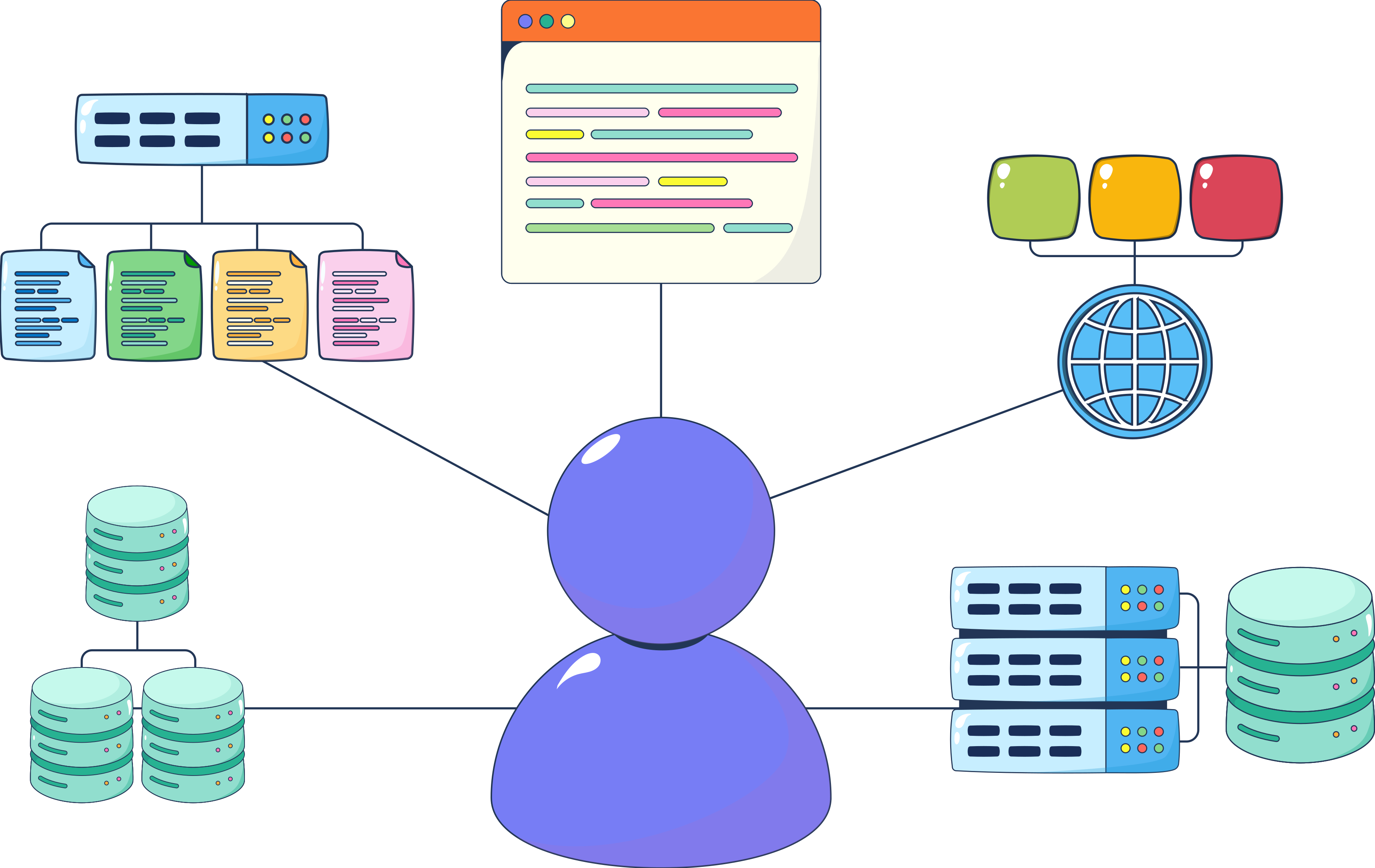
LinkedIn’s System Design interviews evaluate your ability to build scalable, reliable, and performance-efficient systems that align with real-world use cases in social networking, content distribution, and professional communication. You’ll be tested on how you structure large systems, handle trade-offs, and ensure reliability at scale, which is critical for a platform with hundreds of millions of users.
1. Design LinkedIn’s feed ranking system
Problem statement: Design a personalized news feed for LinkedIn that shows relevant posts, job updates, and articles based on user interests and connections.
Key features:
- Real-time aggregation of posts from users’ connections and followed entities.
- Ranking based on relevance, freshness, and engagement likelihood.
- Filtering out spam, low-quality content, or duplicated posts.
- Optional: Support reactions, comments, and resharing.
Design highlights:
- Use distributed queues and a pub/sub system (e.g., Kafka) to collect activity signals.
- Store user graph in a graph DB or key-value store (e.g., RocksDB, Redis).
- Apply a ranking model using machine learning with real-time scoring.
- Precompute feeds for highly active users to reduce latency.
- Use sharded databases and caching (e.g., Memcached) for fast delivery.
2. Design the LinkedIn messaging system
Problem statement: Build a real-time messaging system like LinkedIn Messaging or InMail that supports direct and group conversations.
Key features:
- Send/receive messages in real time.
- Message history and delivery acknowledgment.
- Typing indicators, read receipts, and media support.
- Optional: Offline message storage and spam filtering.
Design highlights:
- Use WebSockets or long polling for real-time delivery.
- Store messages in horizontally sharded databases with message IDs.
- Use message queues to decouple sending and delivery.
- Store metadata separately for efficient retrieval (e.g., last seen, delivery time).
- Ensure idempotency and encryption for privacy/security.
3. Design a job recommendation system
Problem statement: Recommend relevant jobs based on profile, activity, and preferences to users.
Key features:
- Real-time and batch recommendations.
- Matching based on location, skills, interests, and engagement signals.
- Feedback loop based on user interaction.
Design highlights:
- Store structured user/job data in scalable document stores.
- Use collaborative filtering and content-based recommendation models.
- Apply filtering layers (location, job type, availability).
- Precompute results using offline batch jobs (e.g., Hadoop/Spark).
- Use feature stores and vector databases for semantic matching.
Additional system design questions
- Design LinkedIn’s people you may know (PYMK) system: Suggest new professional connections using mutual contacts, interaction history, and profile similarity.
- Design LinkedIn live: Architect a live streaming service with interactive comments, reactions, and delay buffering.
- Design LinkedIn notifications system: Deliver relevant and timely notifications across web, mobile, and email while avoiding overload.
- Design a URL redirection service: Build something like
lnkd.in/xyzwith analytics, expiration, and redirect limits. - Design a resume parser API: Ingest resumes and extract structured data using NLP and ML models.
Behavioral interview questions at LinkedIn
LinkedIn’s behavioral interviews focus on leadership, ownership, and the ability to navigate ambiguity—all essential for high-impact roles in fast-paced teams. They’re also deeply tied to LinkedIn’s cultural values: transformation, integrity, collaboration, and results. Expect questions about teamwork, feedback, innovation, and stakeholder management.
Using the STAR method (Situation, Task, Action, Result) helps keep your answers clear and impactful.

1. Handling ambiguity
Question: Tell me about a time when you had to solve a problem without clear guidance.
STAR answer:
- Situation: I was asked to revamp an internal tool with minimal documentation or existing requirements in my previous role.
- Task: I had to understand the tool’s purpose, identify pain points, and propose a redesign.
- Action: I initiated user interviews, documented workflows, and collaborated with stakeholders to define the scope.
- Result: We launched a new version that reduced internal support requests by 30%.
2. Driving results through collaboration
Question: Describe a project where you worked across teams to deliver impact.
STAR answer:
- Situation: I worked on a project integrating a third-party analytics tool across several microservices.
- Task: My role was to coordinate implementation without disrupting existing services.
- Action: I created a shared tech spec, scheduled sync-ups, and built a shared testing environment.
- Result: The project launched on time with no significant issues and improved observability across services.
3. Learning from failure
Question: Can you share a time you failed or made a mistake? What did you learn?
STAR answer:
- Situation: I once deployed a configuration change without testing it in staging, which caused a temporary outage.
- Task: I needed to restore service and prevent future incidents.
- Action: I rolled back the change, performed a root-cause analysis, and added a staging validation step in CI.
- Result: No similar issue occurred afterward, and we improved release reliability.
Additional behavioral questions
- Influence without authority: Share a time you had to convince someone without formal power.
- Handling feedback: Talk about how you’ve received or implemented tough feedback.
- Making data-driven decisions: Describe a decision you made based on data rather than intuition.
- Mentoring or leadership: Talk about how you guided someone junior or led a small team.
- Pushing for innovation: Describe when you brought a new idea to life in a team or product.
Level up your skills with AI-driven mock interviews
While building technical and communication skills is crucial, simulating real interviews is just as important. One effective way to bridge the gap between practice and performance is through an AI-powered mock interview. Practicing with AI-driven mock interviews can simulate real interview conditions and highlight areas for improvement, including code clarity and behavioral fluency. With tailored insights and performance tips, you can pinpoint areas for improvement, boost your confidence, and walk into your interviews better prepared than ever.
Focus your prep
Acing LinkedIn interviews goes beyond writing code—it demands thoughtful system architecture, the ability to explain trade-offs, and well-framed personal experiences. With a focused prep plan covering System Design, DSA, and behavioral interviews, you’ll be well-positioned to make a lasting impression and secure your role at LinkedIn.
Related Videos